
The modern diet is a love letter to coronary catastrophe, a wrecking ball, a gastronomic hooligan that leaves your body, particularly your heart, battered, bruised, and hopelessly overworked.
While there are plenty of opinions and recommendations, there’s no such thing as a single healthy diet that benefits everyone. Each unto their own.
• Would you take advice from the US Academy of Nutrition and Dietetics if you knew they are shareholders with vested interests in the ultra food companies PepsiCo and Nestle?
• Would you take nutritional advice from Amazon if you knew they bought Whole Foods from which they are now selling pharmaceuticals?
Wellbeing isn’t about chasing the latest miracle cure or trendy treatment. More often than not, the smartest move is to simply quit the nonsense that’s dragging you down – ditch the cigarettes, rein in the excess booze, scrap the dodgy drugs, cut out the mountains of processed junk, and rethink those so-called “lifestyle” choices that do more harm than good.
Here are 25 suggestions, in no particular order:
- Food It’s blindingly clear, like being hit in the face with a wet kipper, that the self-anointed titans of the so-called “elite” class have decided that culling the global herd is their new party trick. Food is one of their weapons and people are falling for it.
The best kept secret in medicine is that given the right conditions, the body heals itself.
Food is fuel for the body yet at the same time it can be a joy. For centuries food has been bringing people together to a communal table, allowing them to talk a while sharing their stories, their emotions, their experiences and their lives.
There’s nothing better than enjoying food with friends. Food gives us an instant connection to our traditions and beliefs. Most important it’s the way mothers in every country or tradition say “I love you”
An appetite for food is much like an appetite for life. Food changes our mood and can induce contentment well beyond that of the digestive tract. It’s the modern equivalent of sitting around the campfire and exploring memories. Having a sense of belonging; a place in the world. For me a delivered pizza doesn’t tick any of these boxes.
The subject of diet is far too colossal to address comprehensively here but know that the low frequency foods include processed, fried, sugar-heavy and those with artificial additives or preservatives.
2. Beneficial Frequencies – Nikola Tesla once said “ If you wish to understand the Universe think of energy, frequency, and vibration.“ A cat’s purring at between 25 to 50 hertz has been shown to improve bone density, build bone strength, support wound and fracture healing, and stimulate bone fracture repair. It can also provide pain relief and help manage breathlessness and inflammation.
Humming, that most primitive of lullabies, turns out to be more than just the soundtrack to bath-time bravado. It’s a biological whisper, a sotto voce symphony for the soul. When you hum, you stir the vagus nerve, the body’s own internal concierge, quietly regulating everything from heartbeats to hangovers. This gentle vibration coaxes the nervous system out of its usual panic-stricken fluster.
The frequencies involved are not just any sounds, they’re curated by evolution to soothe, like the acoustics of womb water or a mother’s voice on a Sunday afternoon. They open airways, refine breath, and lace the bloodstream with a more elegant dose of oxygen. They unclog noses, temper the pulse, and nudge the mood ever so slightly upwards, less Prozac, more Zen monk with a sinus rinse. It’s mindfulness, not as an app or aspiration, but as a hum in your throat: primal, present, and quietly miraculous.
3. Cellphones There are plenty of articles about how the overuse of cellphones can be harmful to the brain. Instead of repeating this, let’s go back 20+ years to learn what happened during the first major study on cellphone safety.
The Wireless Technology Research programme was industry funded and headed by Dr. George Carlo. Carlo, who has a PhD in pathology and a law degree, was handpicked by the cellphone industry to defuse the public-relations crisis that threatened their precious profits.
He was hired to prove once and for all that cellphones were safe. Critics suspected that Dr. Carlo would be the front man for an industry cover-up. But his findings didn’t line up with his paymaster’s requirements. After 7 years of research Dr. Carlo concluded cell phones were detrimental to human health.
In February 2000 Dr Carlo took the stage to present his final report at the wireless industry’s annual conference. He had spoken barely 10 minutes when two heavy set men forcibly escorted the scientist to a taxi outside and waited until it pulled away.
Dr. Carlo was immediately removed from the program and the public spin machine was put into action to smooth out any damage his announcements might have made.
If your progeny, fresh from their latest sulk, comes pleading for a mobile phone, eyes brimming with entitlement, take them gently aside, as if you’re about to impart the secret of the universe. Ask them, with a conspiratorial tone, what substance is fatal to Superman. They’ll perk up, brightened by pop culture trivia and the whiff of success. “Kryptonite,” they’ll say, smug as a quiz show finalist.
And that’s your moment. Lean in and deliver it with the calm precision of a surgeon: “Exactly. Kryptonite. And for humans? It’s the thing you’re begging me to buy. It fits in your pocket and rots your soul one dopamine hit at a time.”
Then walk away, slowly. Let the silence do the parenting.
4 Rapeseed oil.
Consider the honesty of oils. Olive oil comes from olives, obviously. Avocado oil? From avocados. Quelle surprise. Sunflowers give sunflower oil, sesame seeds yield sesame oil, and peanuts press themselves into peanut oil with admirable transparency. Each one wears its origin on its label like a botanical name tag.
And then there’s rapeseed oil. Or, as it’s been rebranded for the nervous dinner party host, canola. What, exactly, is it? Well, less Mediterranean harvest and more industrial lubricant. This stuff began life not on a rustic hillside but in the gloopy bowels of agricultural engineering, where it served as everything from machine grease to a base for synthetic rubber, and as the agent that made colours pop in glossy magazines. Quite literally, an oil that shines.
Now, cast your mind back to that unsettling culinary chapter of the 1990s: Mad Cow Disease. A dinner-party horror story with real teeth. The theory, or at least one of the juicier ones, suggests that cattle were fed on an unholy slop of rendered sheep. Sheep that had themselves been dining on rapeseed oil. Those sheep, as it turns out, were prone to something called scrapie, a neurotic, twitchy, degenerative disorder with all the charm of a bygone asylum.
And lo, the cows twitched. And then the humans. The rapeseed connection? Not proven, of course. No peer-reviewed bow tied neatly around the theory. But “interesting”, as the scientists like to say. And after rapeseed oil was banished from the feed troughs, reports of scrapie evaporated like cheap cologne. A coincidence, perhaps. Or maybe just the sort of truth that’s too inconvenient to taste-test.
So next time you see “canola” on a label, remember, it’s not from a fruit, or a flower, or a nut. It’s from a lab. And it used to shine in Vogue.
5. Nitric Oxide (NO) Not a nightclub drug, nor an obscure prog rock band from Düsseldorf, but a molecule, a gas, no less, that your body makes and, rather flatteringly, desperately needs. It’s not glamorous, nor will it sparkle.
But in 1992, Science magazine, which is about as rock ’n’ roll as a haemorrhoid clinic, named it “Molecule of the Year.” Not the molecule you wanted, like caffeine or gin, but the one your blood vessels have been writing sonnets about.
NO, as it’s wryly abbreviated, is the body’s natural relaxant. It saunters through your bloodstream like a maître d’, whispering to your arteries to just chill out and widen a bit. The result? Better blood flow, lower pressure, more oxygen ferried about like urgent gossip. Your muscles perk up. Your heart stops panicking. You, improbably, perform better at exercise. And it doesn’t stop there. NO is also something of a neural diplomat, helping nerve cells chit-chat across the synaptic party.
It gets better. In your immune system, NO is the bouncer: dispatching pathogens with all the subtlety of an East End debt collector. It even dabbles in arterial housekeeping, scrubbing away the early whispers of plaque buildup like a molecular Marie Kondo.
Where does one find this chemical overachiever? In leafy greens, beetroot, and supplements like L-arginine. But researchers in Sweden (who else?) discovered that humming, yes humming triggers the release of nitric oxide in the nasal cavity. Which is really just science catching up with the instincts of monks and bored commuters. When you hum, your nasal passages vibrate like a tiny, personal cathedral, prompting this quiet chemical miracle.
So the next time you’re asked to hum, don’t be embarrassed. You’re not being eccentric, you’re biohacking. You’re stimulating the molecule of the year. You’re conducting an invisible symphony in your sinuses. And in the rather underwhelming pantheon of bodily gases, nitric oxide is the one you want in your corner.
6. DMSO (“The People’s Medicine”) In the pantheon of misunderstood marvels, DMSO stands like a tragic hero, reeking faintly of garlic and rebellion. It is, in my opinion, the most potent free radical scavenger ever to grace a Petri dish or a pulled muscle.
It is a molecular Swiss Army knife with the élan of a Parisian apothecary and the versatility of a back-alley fixer. It soothed inflammation, mended wounds, whispered sweet nothings to swollen joints, and all the while worked its alchemy inside and out like a biochemical Bond.
Naturally, this couldn’t be allowed.
Despite being poked, prodded, and peer-reviewed across an eye-watering 100,000 patients, DMSO was dragged before the tribunal of Big Pharma. And lo, the verdict: too effective, too cheap, and far too independent for comfort. The industry’s response was swift, clinical, and almost poetic in its hypocrisy. They deemed it untrustworthy, a quack’s elixir, the snake oil of science.
Not to be left out of the performance, the FDA, an association we’re repeatedly told to trust, brought the curtain down in November of 1965. No more DMSO. No more hope. No encore.
Enter Dr. Stanley Jacob, a man of medicine turned martyr, who had the gall to champion this rogue remedy. His reward? His offices raided. His name dragged through bureaucratic sludge. His charge? Insufficient evidence. As if curing pain without a five-digit price tag were some kind of felony.
A pharmaceutical executive, caught in a rare moment of candour, revealed what a Pharma rep said to him: “I don’t care if DMSO is the major drug of our century, and we all know it is, it isn’t worth it to us”
And so DMSO was banished to the stables, repurposed as liniment for horses, because apparently, it’s fine for thoroughbreds but not for taxpayers.
Yet like all great icons, it couldn’t be buried. Today, DMSO is back onto our shelves, cloaked in ambiguity, sold as a solvent, whispered about in wellness circles, passed between the converted like samizdat.
An ebook on DMSO and other essential elements is available to our readers at no charge:
http://www.resourcesforlife.net/product/five-essential-elements/
7. Toothpaste: put less toothpaste on your toothbrush than they show you in the TV ads. A pea-sized amount will do just fine.
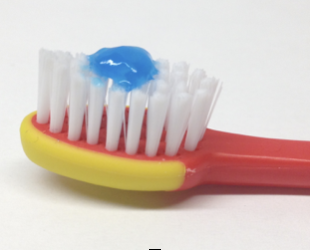
In 2012, a team of diligent boffins from Harvard and China Medical University sifted through 27 studies with grim patience. Their conclusion? Fluoride, the same stuff piped into your tap with the benevolent insistence of a government dental hygienist, might, just might, be shaving a few IQ points off the top of our next generation. A small price to pay, perhaps, for the illusion of civic hygiene.
But no sooner had this unsettling murmur emerged than the American Dental Association, white coats pressed, smiles fixed, leapt onto its dais with the practised assurance of a well-fed choir denying the existence of sin. Community water fluoridation, they declared, remains perfectly safe. Beneficial, even. Positively saintly. As for the studies? Interesting, yes. Conclusive? Absolutely not. No need to tinker with the taps just yet.
Thus, we are asked to raise a glass of fluoridated water, naturally, to modernity, where doubt is dosed and dissent is rinsed clean with a reassuring rinse of institutional certainty.
8. Mouthwash. The best mouthwash, ironically, is the one that comes free, bespoke, and on tap: your own saliva. Nature’s own spit-polish. Perfectly pH-balanced, enzyme-rich, and delivered in real time, assuming, of course, that your mouth hasn’t already been turned into a chemical weapons testing site.
Because, and here’s the inconvenient truth, those fluorescent, minty potions we’re sold with promises of alpine freshness and seductive breath are less hygiene and more hazmat. The long-term use of these chemical cocktails, with their alcohol bases and industrial antiseptics, has been rather persuasively linked to oral cancers.
Yes, cancers. From something sold next to toothpaste, and marketed like aftershave for your gums.
But don’t expect to find that on the bottle, nestled between the frosty mountain graphics and the promise of twelve-hour confidence. After all, what’s a little carcinogenic risk in the name of feeling minty-fresh?
You may have seen a TV ad where a woman’s teeth fall out of her mouth into her hands. Of course it’s a bad dream. Then as she brushes her teeth blood comes out of her mouth.
Were you shocked? Could blatant scaremongering have been the purpose behind the ad for Corsodyl? The tagline is “Because losing a tooth in real-life is worse than a bad dream.”
Corsodyl, a GlaxoSmith Kline product is supposed to fight gum disease and help numb the pain of mouth ulcers. Unfortunately some formulations contain chlorhexidine digluconate. The chemical has been linked to serious heart conditions.
In 2011, a verdict of ‘death by medical misadventure’ was recorded at Brighton County Court after a patient died from anaphylactic shock after using Corsodyl mouthwash administered to her in a dental practice.
9. Non-Stick pans
The non-stick pan is modernity’s great culinary sleight of hand. A marvel of convenience, a miracle of science, and a quiet little health hazard humming softly on your hob.
Most are coated in something called polytetrafluoroethylene, which sounds like a villain in a lab coat and behaves accordingly. When overheated, as all pans eventually are by the distracted, the drunk, or the dinner-party-show-off, it begins to decompose into a noxious chemical mist.
This invisible gas can give humans a delightful bout of what’s cheerily known as polymer fume fever, a sort of Teflon hangover. For birds, it’s rather more final, a feathered death sentence.
Then there’s the charming issue of scratches, those delicate spiderwebs that appear after a few months of spatula abuse. Once compromised, the pan starts quietly leaking its innards into your scrambled eggs.
And if your pan is old enough to remember dial-up internet, it may still be laced with PFOA, a molecule so sinister it’s been linked to cancer, hormonal mayhem, and quite possibly the heat death of the universe.
If you’d like a cinematic primer on just how deep the rabbit hole goes, watch Dark Waters with Mark Ruffalo and Anne Hathaway.
It’s a thriller for anyone who’s ever fried an egg and wondered what else might be sizzling beneath the surface.
10. Dirtest places to pick up germs
- Your kitchen sink: With more dirt than a typical bathroom, and over 500,000 bacteria per square inch in the drain, your kitchen sink basin and faucet are teeming with nasty germs.
- Aeroplane bathrooms: Never mind the fecal bacteria that’s commonly found on door handles and taps, the worst part is the tornado of germy particles that’s spewed into the air when you flush the toilet (more on flushing below).
- Wet laundry (even after it’s been washed): A dirty pair of underwear contains about a gram of you know what, and this gets spread around the entire load of laundry very quickly. It’s not until you dry the clothes that the germs are destroyed. Dry your clothes in the sun (see item 25).
- Public drinking fountains: All public drinking fountains are loaded with germs, but those in schools, which contained anywhere from 62,000 to 2.7 million bacteria per square inch of the spigot, are the worst.
- Shopping cart handles: While you’re innocently shopping in supermarkets, your hands are grasping a handle covered in saliva, bacteria and even fecal matter from dozens of people who used the trolley before you.
11. Respect your navel. The first body part to form after conception is the navel. The belly button. That small, unassuming dimple of flesh we mostly ignore unless we’re trying not to gaze at it metaphorically.
But there it is: the original umbilical handshake, our first and most intimate connection to life. Before eyes, before brains, before the chaos of personality, there was the navel.
Behind this fleshy punctuation mark lies the Pechoti gland, a little-known and much-theorised node, purportedly wired into a Byzantine tangle of 72,000 veins, an improbable number that’s either Ayurveda’s greatest flourish or a statistical acid trip. Supposedly, if you were to stretch all your blood vessels end to end, they’d wrap around the Earth. Twice. Which is impressive, if a bit macabre, and certainly makes one’s circulatory system sound like an ambitious travel blogger.
And now, enter the curious realm of the navel spa treatment, an ancient wellness ritual making a chic little comeback, courtesy of your oil shelf. The practice involves gently dabbing your belly button with castor oil, as if it were a sacred relic.
The effects, we’ve read are nothing short of miraculous. This humble anointing is believed to nourish organs like a wet nurse, soothe menstrual cramps with the compassion of a romantic poet, detoxify like a wellness influencer’s juice cleanse, and bestow calm through nerve stimulation. It hydrates, heals, and, best of all, balances the body’s energy centres, a phrase which may mean everything or nothing, but does so with an undeniable sense of cosmic flair.
So go ahead: give your belly button a little love. Rub it down with oil. Whisper sweet nothings. You never know. It might whisper back.
12. Margarine
Margarine, that pale pretender to the dairy throne, began its dubious life not on toast, but in the cold, utilitarian corridors of poultry science. It was, astonishingly, concocted to fatten turkeys, a Frankensteinian blend of ambition, chemistry, and culinary tone-deafness. Alas, the turkeys promptly died, presumably from a combination of confusion and quiet despair.
Faced with a warehouse full of death paste and the looming spectre of financial ruin, the investors did what any self-respecting capitalist alchemist would do: they rebranded. If it couldn’t plump up poultry, perhaps it could clog up the arteries of the public instead.
But there was a snag. The stuff was the colour of old candle wax, entirely unappetising and about as edible-looking as shoe polish. So, with a flick of the food industry’s wand and a generous splash of yellow dye, margarine was given the sunny hue of country churned butter, et voilà! A new kitchen imposter was born.
And thus, margarine slithered its way onto breakfast tables and into our hearts, literally, where it’s been cheerily masquerading as butter ever since, all the while humming the cheerful tune of profit over poultry.
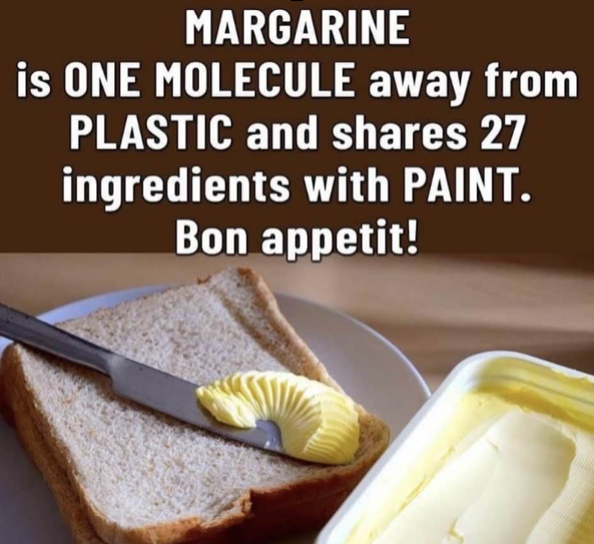
Here’s what you need to notice about margarine: it doesn’t rot. It doesn’t smell. It doesn’t invite even the tiniest microbe to throw a party on its surface. No mold, no fuzz, no buzzing flies, not even those irritating fruit flies with their high-maintenance palates, will come anywhere near it. That should set off alarms louder than a fire drill at a convent.
Why? Because margarine is, for all intents and purposes, nearly plastic. Yes, plastic. The kind you’d scoff at if someone suggested melting down your Tupperware and slathering it on your morning toast. Yet, here we are, comfortably spreading what’s essentially synthetic wax and calling it food.
The original health argument for margarine was that it contained less saturated fat than butter, a claim that was once the gospel of nutritionists everywhere. But science, being the stubborn party pooper it is, has since cleared saturated fat of most of its sins. So that old chestnut? It’s dead in the water. Margarine’s supposed “health benefits” have about as much credibility now as a horoscope in a cheap tabloid.
13. Weight loss jabs: the quick fix du jour for anyone desperate enough to pin their hopes on a syringe rather than, say, eating less and moving more. Yes, they can work, if by “work” you mean coaxing your body into a chemical rebellion that sometimes manifests as nausea, vomiting, diarrhoea, or the opposite, constipation. Charming, really.
But don’t stop at the mild inconveniences. There’s a darker cast lurking behind the curtain: gallbladder troubles, pancreatitis, kidney strain, and the ominous spectre of thyroid tumours. And because science likes to keep us on our toes, the long-term consequences remain something of a mystery wrapped in a clinical trial.
Oh, and if you think you can just stop these injections cold turkey, think again. Prepare for the classic yo-yo: rapid weight regain that could make your scales weep. Meanwhile, your psyche might not escape unscathed either. Body image woes and disordered eating often lurk in the shadows of these pharmaceutical promises.
Some users of Ozempic (for diabetes and weight loss) report anxiety, mood changes, or disordered eating behaviours.
14. Psychiactric drugs are the third leading cause of death, This is too important an issue for me to write a few paragraphs on, so for those readers interested in the subject, here’s my reliable source. Click to read:
Psychiatric Drugs Are The Third Leading Cause Of Death
15. Mental Health.
The nation’s mental health is at risk, especially among our teenagers, who seem to be drowning in an ocean of anxiety, depression, and suicides that are rising faster than anyone can quite explain.
The headlines are grim and relentless. Whether it’s the mounting stresses of modern life, the long-term effects of prescription meds, or the ever-polarising COVID vaccine, mental health is dominating the news cycle like a bad soap opera with no commercial breaks.
In response, the NHS, bless its beleaguered heart, has decided to roll out A & E facilities for mental health crises across the UK. Because apparently, we’ve reached the point where psychological breakdowns require urgent care alongside fractured limbs and heart attacks.
Elizabeth Wurtzel, that sharp-witted chronicler of despair, put it best:
“A human being can survive almost anything, as long as she sees the end in sight. But depression is so insidious, and it compounds daily, that it’s impossible to ever see the end.”
And she’s right. Depression isn’t a passing cloud; it’s a relentless fog that smothers hope before you can even recognise it.
Mental illness doesn’t discriminate. It doesn’t care if you have a good job, a loving family, or a sterling reputation. When the darkness sets in, nothing you’ve built feels real or valid. All you hear are the voices telling you you’re not enough, the memories of failures you thought you’d buried alive.
Those battling depression carry invisible wounds. They fight a war we often can’t see or understand. The pain is heavy, unyielding, and for many, it feels endless.
We must stop the stigma, because everyone has struggles, and mental health is no different from any other illness. If you know someone fighting this silent battle, reach out. Show up. Because life is hard enough, but it’s exponentially harder when your own mind becomes your greatest enemy.
“People don’t fake depression….they fake being okay. Remember that. Be kind.” Robin Williams
16. Sports/Energy drinks are heavily promoted to convince exercise enthusiasts they’re a healthy way to replace electrolytes lost during training. This is marketing sleight of mouth at best. Sports drinks don’t quench your thirst; they actually slow down hydration. In addition:
• you’re probably swallowing more calories (sugar) than you just burned off
• the high sugar content cancels out any electrolyte benefits
• there’s zero protein in sports drinks. Bad news for muscle builders.
• high sugar levels usually cause a subsequent energy crash
The Academy of General Dentistry published the results of a study which measured the high acid content in sports drinks. The report evidenced that damage occurs to the body after only 5 days of consistent consumption.
Diet sodas are no more than a wolf in sheep’s clothing. For years, ‘Big Soda’ companies have been handing out millions of dollars in an attempt to prove that their drinks are NOT the cause of obesity.
17. Flush your toilet with the lid DOWN. Robert Verkerk (Alliance For Natural Health) released a video years ago that showed the microhaze forming after flushing a toilet.
The haze hovered for almost two hours after flushing. If you close the lid after sitting on the toilet, the haze is contained within. If you have a bad case of diarrhoea and you don’t close the lid….let’s just hope your soap, face flannel and toothbrush aren’t located close by. You can guess why.
18. Vaping I’ve never been a fan of inhaling poison for fun so I’m not writing from experience here. My instincts tell me that e-cigarettes are merely a big bad wolf in sheep’s clothing, especially after it’s been repeatedly shown that
Alliance For Natural Health:“The more you use vapes, the more damage is caused to the DNA of the cells in your mouth. Damage to vapers’ DNA was 2.6 times higher and smokers’ 2.2 times higher, than those who had never smoked or vaped. Sweet flavoured vapes created the most damage. The findings are published in Nicotine & Tobacco Research produces a respiratory disease called “popcorn” lung – similar to a coronavirus.”
Many e-cigarettes contain one questionable ingredient, glycerol, a by-product of biodiesel fuel production. Yuck!
19. Microplastics pose serious health and environmental risks. They contaminate water, food, and air, entering the human body and potentially causing inflammation, hormone disruption, and cellular damage. In ecosystems, they harm marine life and accumulate in the food chain. Their persistence and invisibility make them a growing global threat to health.
There’s not a lot we can do to prevent ingestion but I bought a microscope recently off Facebook Marketplace to look closely at what we’re eating, if only to allay suspicions.
Be aware and keep your eyes open for potential methods of prevention.
20. Teeth & Gums. You’ll probably agree that your teeth and gums need better care than you’ve been giving them. Your dental bills are confirmation of that. If your mouth isn’t healthy, there’s little chance that the rest of your body will be until this imbalance is resolved.
What people are beginning to appreciate is the importance of the connection between the mouth and the rest of their body. Here’s an insight from What Doctor’s Don’t Tell You:
“A man goes to the dentist and says, “I’ve got a terrible toothache”. The dentist takes one look at the tooth and says, “There’s nothing wrong with that tooth. You need to get your intestines cleaned out”. The man undergoes colonic irrigation and the pain in the tooth disappears.
Another man who’s pulled a hamstring muscle goes to see his dentist for a check-up. The dentist makes a quick realignment of one of his teeth, and his hamstring problem is cured. These seemingly fantastical cases are just a few selected from the patient files of one of a small handful of holistic dentists in Britain.
Everything, literally everything in your body is connected. One of the best investments you can make in your long term dental health is Gum Disease: The Silent Battle In Your Mouth (available on Amazon).
21. Mammograms. In 2017, Switzerland did something refreshingly sensible: they ditched mammogram screenings altogether, deeming them neither effective nor safe. Not long after, the European Breast Guidelines followed suit, no more annual mammograms for women aged 40 to 44, thank you very much. Instead, the advice now is to stagger them every two to three years for women between 45 and 74.
Why? Because let’s be honest: mammograms have always been a dubious affair. Painful? Check. Expensive? Absolutely. Effective? The evidence suggests not much. Harmful? Oh yes, those doses of radiation stack up like an unwelcome gift, causing more grief than gratitude. The risks, frankly, outweigh any supposed benefit.
And yet, women rarely get the full story. The warnings are muffled, like a whispered secret. Because modern medicine, for all its talk of care and cures, increasingly smells of something far less noble: cold, hard cash.
In the words of What Doctors Don’t Tell You “Take, for instance, the use of mammograms as a national screening method to detect breast cancer. Radiologists know it’s inadequate technology that picks up only a third of cancers and misses around 2500 cancers in the UK every year in women with dense breast tissue.
Mammograms break open the breast lump csusing the parsites within to become opportunist and potentially exacerbate the spread of cancer.
There are better options. One, low-dose positron emission mammography (PEM), is more sensitive, especially in women with dense breast tissue, as one study published recently has demonstrated. It detected 24 cancers in 25 women who had already been diagnosed with the condition. That’s a 96 percent success rate, while standard mammogram screening detected just 62 percent of cases.
Thermography detects heat and not mass, as mammograms do, and, in the 1980s radiologists often used it in conjunction with a mammogram. It was the perfect early-warning system that could predict a cancer that was not visible to mammography. And that was the problem. It was too sensitive, and while it would save many thousand of lives, medicine wasn’t – and isn’t – in the business of prevention, but only in treatment.”
From The Los Angeles Times:
“More than half of breast cancers newly diagnosed in the United States are likely cases of mistaken identity that subject women to needless anxiety, treatment and expense, researchers reported Wednesday in the New England Journal of Medicine”.
By ‘mistaken identity’ I’d suggest the LA Times really meant incorrect diagnosis.
22. Soy it turns out, is a bit of a hormonal diva. Loaded with phytoestrogens, those plant-based imposters that mimic the oestrogen already running the show in our bodies. It sounds quaint and wholesome, but consuming large amounts of the stuff is linked to an alarming list of female health woes: breast cancer, endometriosis, uterine fibroids, infertility, and the dreaded low libido. So much for nature’s gentle touch.
Take edamame, those trendy little green beans everyone seems to be cramming into their Instagram bowls, they’re unfermented soy, which means the phytoestrogen levels are anything but benign.
A friend recently confided that his girlfriend was wholeheartedly enamoured with soy milk, pouring it liberally over her breakfast muesli like it was liquid gold. She hadn’t quite connected the dots between her daily soy habit and the frequent trips to the doctor, trying desperately to make sense of her increasingly irregular menstrual cycle.
Still on the fence? This should change your mind https://www.facebook.com/reel/4099337100356009
23. Blood Sugar TheTruthAboutCancer took a look at the sugar consumption trends over the past 300 years, revealing:
- In 1700, the average person consumed about 4 pounds of sugar per year.
- In 1800, the average person consumed about 18 pounds of sugar per year.
- In 1900, individual consumption had risen to 90 pounds of sugar per year.
- In 2012, more than 50% of all Americans consumed 1/2 pound of sugar per day — translating to a whopping 180 pounds of sugar per year!
In 1890, only 3 people out of 100,000 had diabetes. In 2012, almost 8,000 out of every 100,000 people was diagnosed with diabetes. Today in the UK alone the figure for diabetes is 1 in every 16 people. This number is rising all the time.
It might help if shops didn’t display a variety of chocolates and sweets at their counters aimed at bored children in the checkout queue.
Diabetes is a major cause of blindness, heart attacks, stroke, kidney failure and lower limb amputation.
Because of the strong link to obesity, the condition has a new name – ‘diabesity.’ Any male with a waistline in excess of 40 inches or a female over 36 inches is considered to be failing their health markers, and obese. Watch that measurement change over the coming years.
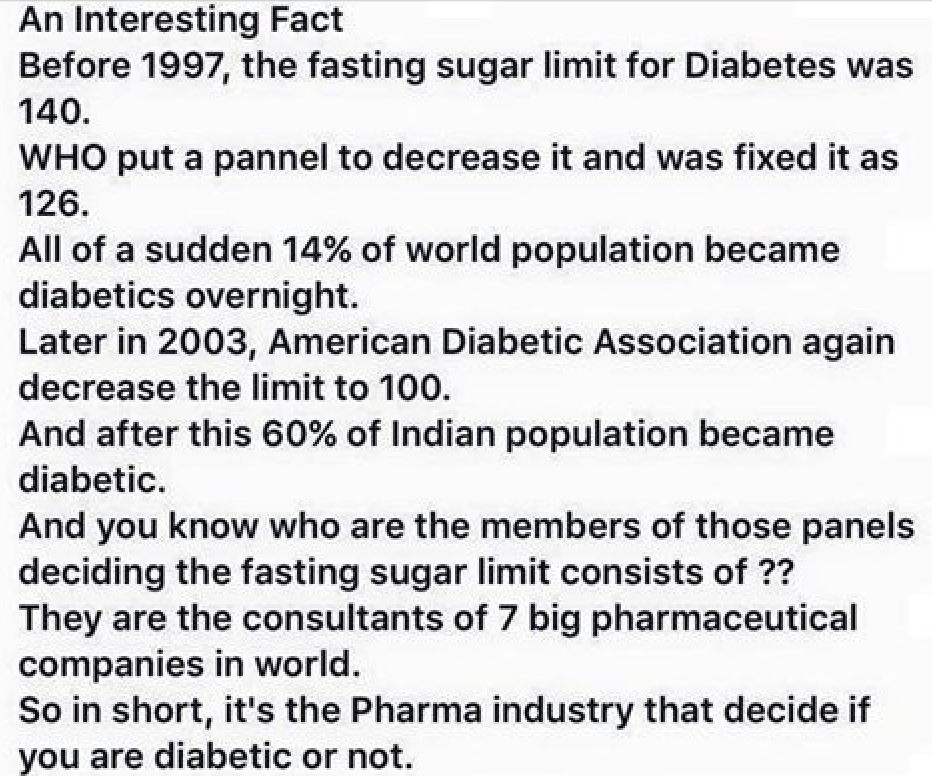
While there are several criteria for measuring diabetes – fasting plasma glucose, before and after meals, the manipulation of diabetes statistics over the years has raised more than an eyebrow:
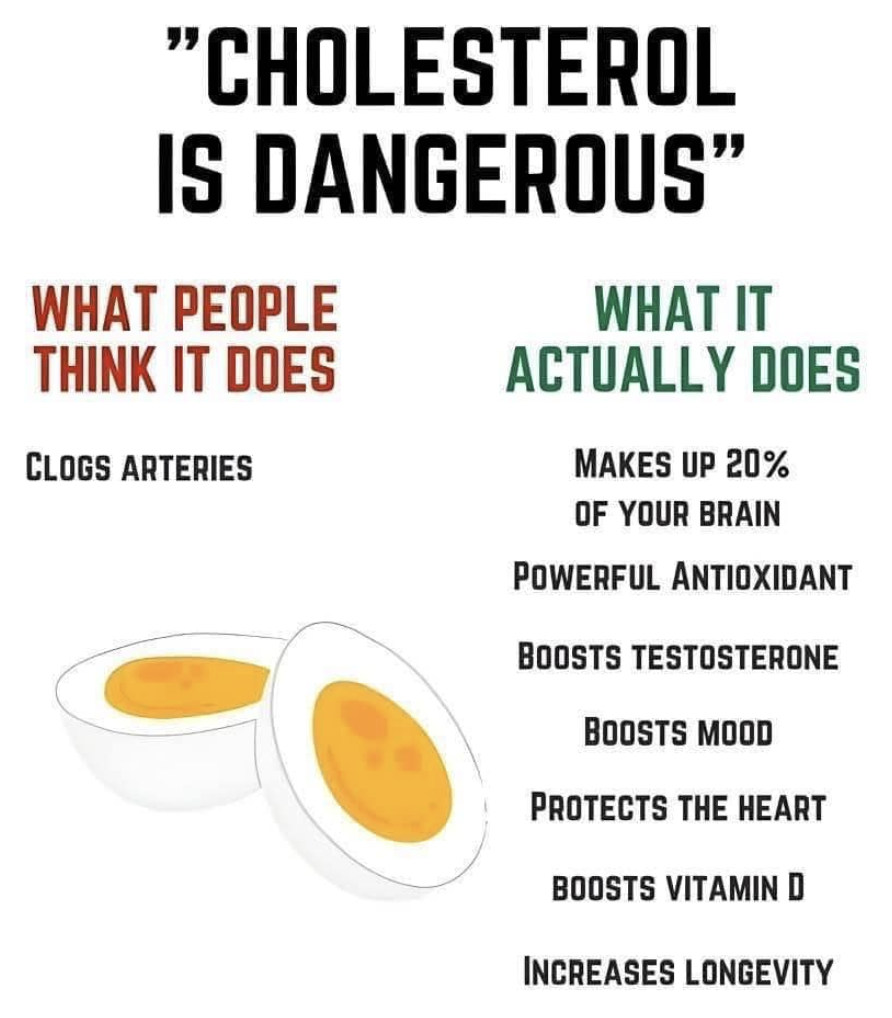
24. Statins When we reach the age of about 40, doctors will recommend we start taking statins, if only to minimise the dangers of high cholesterol. But if our body makes cholesterol and the brain needs it to function properly, what if cholesterol provides more value than harm?
When surgeons open the arteries of someone post heart-attack, they find cholesterol there and therefore conclude that cholesterol caused the heart attack. What if the cholesterol was trying its best to prevent the heart attack?
This is important so please watch https://www.facebook.com/reel/1925151451626570
A retired pathologist said that a blood cholesterol level of 350 to be “perfectly fine”. Today we’re told the reading can’t go over 190 and the doctors want you down to 150. The fattiest organ in the body is the brain and cholesterol is there to protect it from chemicals and heavy metals. Why would we want to reduce cholesterol levels?
Is this image big enough to convey my point?
25. Drying clothes Fewer and fewer people are drying their washing on the line. Sunshine purifies clothes. Washing machines are so efficient these days that you can drastically reduce the amount of washing powder you use. We use a teaspoonful of home made detergent (a mix of borax, Naptha soap bar and a washing soda plus Castille soap).
Apart from being gentler on the fabrics, helping them to last longer, the sun’s UV rays kill bacteria and mites.. This is especially beneficial for bedsheets and towels.
If you’d like to learn more about ways to improve your health, get yourself a copy of The Body Speaks
Graeme Dinnen
ResourcesForLife.net
Leave a Reply