
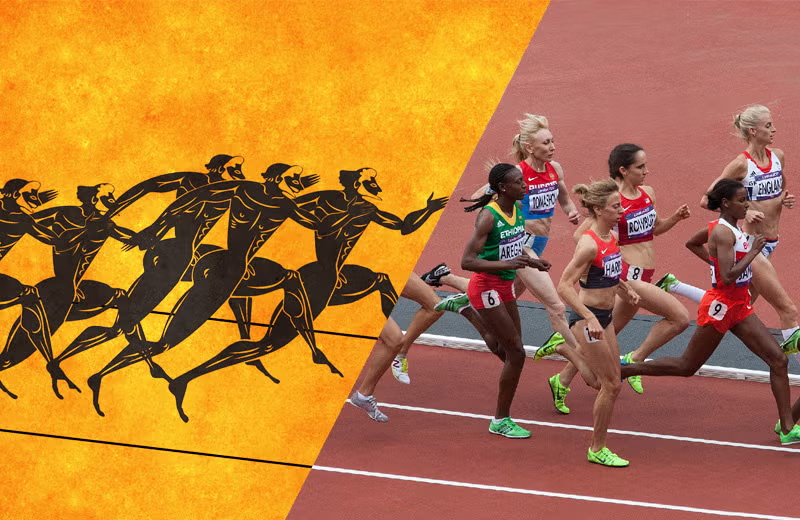
The Modern World Is Not Working As We Hoped: A Comparison of Ancient and Modern Times
There’s a seductive smugness about modernity, a relentless, self-satisfied chorus of progress that hums behind every new gadget, every rebranded ideology, every Silicon Valley announcement about how much better life is now than it was then.
Yet, as we stagger forward under the dull fluorescent glow of screens, buried under algorithms that know us better than we know ourselves, it is worth asking: is this actually working?
Is the modern world, with its fibre-optic wires and cholesterol-conscious foods, truly an improvement? Or have we been sold a glittering, pixelated dud?
Take medicine. The modern sort, white-coated and antiseptic, is a miraculous thing when it’s not being incompetently peddled by bureaucrats and pharmaceutical conglomerates with the bedside manner of a tax return.
But strip away the surgical steel and patented viruses, and you’ll find something older, more human: the accumulated wisdom of civilisations that didn’t have MRIs but did, quite inconveniently for the progress narrative, have a working knowledge of the body and its mysteries.
Unani, Ayurveda, and the Greeks: What Did They Ever Do for Us?
Unani medicine, that magnificent Arab-Greek hybrid, treated the human condition holistically, balancing the humours before the modern world could even spell ‘holistic.’ Ayurveda, which modern wellness influencers have lifted, butchered, and sold back to us via overpriced turmeric lattes, knew about gut health before anyone thought to sell kombucha in health shops.
And the Greeks, whose medical wisdom we now wave away as quaintly archaic, had the revolutionary idea that diseases might not be the work of angry gods but something more tangible – diet, environment, lifestyle.
We laugh at the idea of Hippocrates using honey and vinegar as medicine, but he would have laughed just as heartily at our insistence that overprescribed antibiotics and the sugar industry’s dietary pyramid are in any way sensible.
The Greeks knew that the body and mind were not separate entities, that illness was not just biological but emotional, social, and deeply, irritatingly human.
The Babylonians, the Phoenicians, and a Legacy We Pretend Not to Need
Consider the Babylonians, an empire of record-keepers and sky-gazers, who gave us astrology and beer, two sciences that remain wildly popular today. They built cities, organised irrigation, recorded laws – brilliant, experimental minds making sense of the world while our modern leaders struggle to organise a functional postal service.
While the Sumerians came up with a complete writing system, the Phoenicians are credited with the first widely used alphabet, an innovation so profound we hardly think about it anymore. Without it, no Shakespeare, no Orwell, no passive-aggressive emails from your boss at 2 a.m.
Yet, we are meant to believe that all intelligence began with the Industrial Revolution, that before electricity, people spent their days bashing rocks together and dying of dysentery. The truth is, for most of human history, the ancients managed to live without antibiotics, without air-conditioning, without podcasts discussing the moral complexity of artisanal oat milk, and somehow, miraculously, they thrived.

– – – – –
Ah, but surgery, that dazzling conjuring trick of the modern age, the sleight of hand that turns calamity into cure, must surely be a recent marvel? Well, no. Not even close. Long before anaesthetic, antiseptic, or the reassuring hum of an NHS waiting room, our ancestors were merrily slicing and dicing. Small copper knives, some dating back to 3000 BC, have been unearthed—primitive, yes, but unmistakably surgical. The ancient Egyptians, ever the overachievers, were scribbling down their medical handiwork as early as 2500 BC. Their ruins and papyri whisper tales of scalpels and sutures, of patients placed trustingly in the hands of men wielding razor-sharp blades.
The Rise of Modern Medicine and the COVID Lies
And so we return to medicine, to the sleek, bespectacled efficiency of the modern health industry, where everything is state-of-the-art until the moment it collapses under its own contradictions. Forensic investigators combing through the wreckage of the COVID-19 years have uncovered a litany of bureaucratic betrayals – lies, fabrications, half-truths wrapped in data-driven justifications.
Governments oscillated between fear-mongering and negligence, pharmaceutical companies danced between saving lives and stock prices, and in the end, many people died, not from the virus alone, but from the systemic failures of the institutions that claimed to protect them.
The ancients would not have had ventilators, but neither would they have had the Kafkaesque absurdity of lockdown policies designed more for optics than outcomes. They would have recognised the disease, observed its patterns, applied remedies from their libraries of botanical and empirical wisdom, and moved forward.
It might not have been perfect, but was our modern approach any better?
Olive Oil and the Art of Faking It
It is impossible to discuss ancient wisdom without mentioning olive oil, that ancient panacea of the Mediterranean, now a supermarket aisle battleground of authenticity versus fakery. Real olive oil is medicine; fake olive oil is industrial sludge with a marketing budget.
The ancients appreciated its value. The Greeks bathed in it, the Romans drizzled it on everything, the Phoenicians traded it like gold.
Today, in the great tradition of modern fraudulence, the market is flooded with adulterated oils, refined beyond recognition, stripped of their healing properties, and bottled with words like ‘extra virgin’ despite being about as virginal as a Soho nightclub at 3 a.m.
The difference between real and fake is the same difference between ancient and modern: one is unpretentious, effective, and deeply human; the other is a glossy lie wrapped in branding.
Hidden Discoveries: Ancient and Modern
Science, modern science, likes to announce its discoveries as if no one had ever thought of them before. It ‘discovers’ mindfulness, fasting, herbal medicine, the microbiome, and slaps a research paper on it, conveniently omitting the fact that ancient civilisations not only knew about these things but actually used them.
And so, we find ourselves here, blinking into the synthetic light of our modern, broken world, still needing what the ancients knew but too proud to admit it. Our medicine has improved, but our health has not. Our knowledge has expanded, but our wisdom has shrunk.
The ancients didn’t have Twitter, but they also didn’t have the mental health crisis that Twitter seems to induce.
Progress, it turns out, is not just about moving forward. Sometimes, it requires looking back.
Graeme Dinnen
ResourcesForLife.net

Leave a Reply