
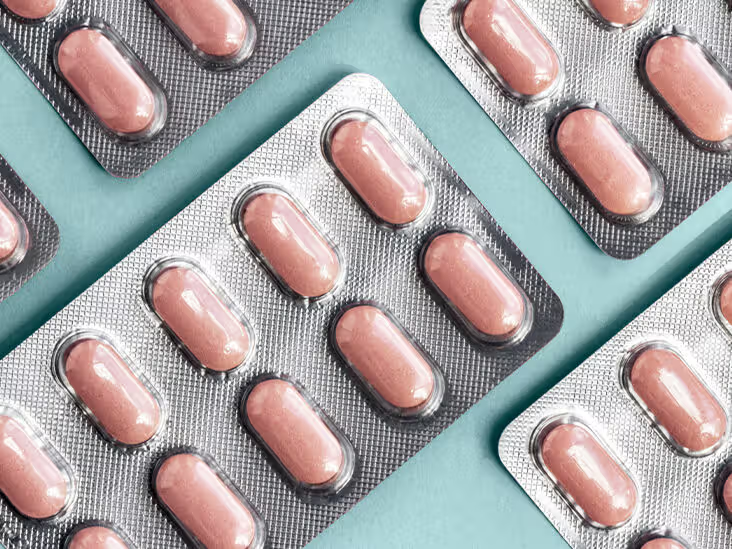
Not long ago, over a plate of something green and good for us, I was chatting with a friend about health. He casually mentioned he’d been on statins for over a year. As if he’d taken up pickleball or intermittent fasting. A hobby, almost.
Naturally, I cocked an eyebrow and said something along the lines of, “But our bodies make cholesterol. Our brains need it. It’s practically the WD-40 of the nervous system. Wouldn’t you be the slightest bit wary of someone trying to turn down the dimmer switch on something evolution thought was a good idea?”
He gave me the kind of look usually reserved for vegans at barbecues. “My doctor put me on them,” he said, flatly. “That’s all I need to know.”
And there it was. Emphatic. End of scene. Curtain down. Physician knows best – do not question, do not Google, do not pass go.
What even are high cholesterol levels these days? The goalposts shift like sand in a hurricane. I suspect it’s less about science and more about supply chain management for pharmaceutical companies. A target rich environment, endlessly renewable, like a Netflix series that refuses to be cancelled.
The statin story is, as most modern myths are, a heady mix of mystery, money, and marketing. No one seems entirely sure how they work. We’re told they simply…..do. Probably. Or not.
What we do know is that the side effects range from inconvenient to nightmarish. Think: muscles that atrophy like the potted plant you forgot on the windowsill. Cellular mutinies. In some cases, testicles that feel as though they’ve spent a long weekend being kneaded by an irate masseuse named Vlad. It’s not ideal.
And yet, once you’re in, you’re in. Statins are a bit like the mafia. You don’t just stop taking them. You don’t quit. You exit in a pine box, with a cardiologist shaking his head and saying “should’ve stayed on them.”
Then there’s Akira Endo, the Japanese biochemist who first wrangled this genie out of the bottle. He died last year at 90 – a longevity that suggests either deep irony or exquisite sushi. Endo, for all his groundbreaking work, never made a yen from it. Sankyo, the pharmaceutical firm where he worked, turned down the chance to cash in. Others, less philosophically burdened, filled the void – and inflated their bank accounts.
But here’s the real kicker: when Endo’s own cholesterol started nudging upward, he didn’t reach for the bottle with his name on it. No. He did something unspeakably radical: he changed his diet. He moved more. He behaved like a grown-up. Imagine that.
It’s almost enough to make you nostalgic for snake oil. At least that came with a travelling show and a dancing bear.
Asked why he shunned the very drug that transformed modern medicine, he gave a perfectly Japanese answer: “The indigo dyer wears white trousers.” Which I believe is a poetic way of conveying a Japanese version of the cobbler’s children.
[There’s an old Spanish proverb that translates roughly to the saying ‘the cobbler’s children have no shoes’. Meaning that someone with a specific skill is often so busy assisting others that their own affairs go unattended. A classic and frustrating conundrum.}

If we’re basing the consumption of statins on what the doctor recommends, here are some other perspectives from doctors who don’t see the official medical narrative as valid.
If you’re taking statins click these links. If you’re not on statins, click them anyway as your doctor will no doubt recommend them to you at some point in the future.
People with high cholesterol don’t get Alzheimer’s – Barbara O’Neill
Cholesterol is not the culprit – Dr Peter Glidden
Statins prolong life – Dr. Aseem Malhotra
Stunned by it – Naturopathic Herbalist
Why are statins so dangerous? – MidWestern Doctor
The Real Truth About Cholesterol And Avoiding Heart Disease – Dr. Keith Scott-Mumby
The Great Statin Con – Alliance For Natural Health
Epigenics lecturer Dr. Bruce Lipton “….it was the histamine that was causing the disease not the cholesterol. People take statins because in their mind the statins are going to reduce the cholesterol problem. This is important for people who take statins – 97 people out of 100 have no benefit from taking them. Of that 100 persons, 20% to 25% of them may have harmful side effects. If the issue is to reduce cardiovascular disease you reduce the stress. For all the statin takers, only 3% will benefit. Those are the ones at the greatest risk for a heart attack.”
Statins – those little chalky pills rattling around in the pockets of every middle-aged man with a cholesterol problem are, rather astonishingly, a class of drugs with an unknown mechanism of action.
And yet, doctors dish them out like Tic Tacs at a bad-breath convention, blissfully unconcerned by the grab bag of potential side effects.
But here’s the kicker: once you start, you can’t really stop. Not unless you fancy rolling the dice on a heart attack. It’s a lifelong commitment, an arranged marriage between you and your prescription bottle.
Just ask Al Gore – though, given his vanishing act from the public stage, I rather suspect he might have quit his statins and learned the hard way.
This newspaper article may not be easy to read but the realities of statin consumption is out there, and growing. In the sidebar you’ll see these words: “Statins have been proven to deplete the body of CoQ10, which is crucial to our health. CoQ10 plays a protective role as an endogenous antioxidant against the development or progression of dementia, especially Alzheimer’s disease.”
Irreversible muscle damage linked to statins
Its time to become your own health Messiah.
Graeme Dinnen
ResourcesForLife.net
Leave a Reply