

I’d like to raise a glass. Not in celebration exactly, more in astonishment. A small clink to the improbable fact of you, and me, being here at all.
To do this, I need to tell a story. All stories worth telling begin with an interruption, and this one is no different, getting underway in Hong Kong during the early months of 1941.
It was a Sunday, brightly awoken by sunshine. My dad, Alec Dinnen, was driving to the Royal Hong Kong Golf Club for an early round. Empire time. Nothing urgent. Nothing historical. Just a man in a car, buoyed by that most durable of fantasies: that tomorrow will be a courteous repeat of today.
He was totally unaware of how his life would change because of one incident that was about to happen.
At one point in his journey, he spotted a car that had pulled over in a layby, its bonnet raised like a white flag. He stopped. In those days people were more likely to offer that small, human deviation from their schedule. The car was hired; the engine was sulking. Dad learned that the passenger was Japanese and, it turned out, that he too was heading for the same golf course.
Problem solved. Fate, for once, didn’t even try to be subtle.
Over the following months, they’d bump into each other at the golf club: a nod, a bow, it was little more than cordial nothingness. Two men sharing good manners while their future was loading a weapon and checking the safety catch.
December 1941 arrived. 5,000 miles away, Pearl Harbour had fallen. Shortly after that, the Japanese 38th Division’s forty to fifty thousand troops rolled over Hong Kong’s fourteen thousand defenders. It was eighteen days of precise, savage arithmetic.
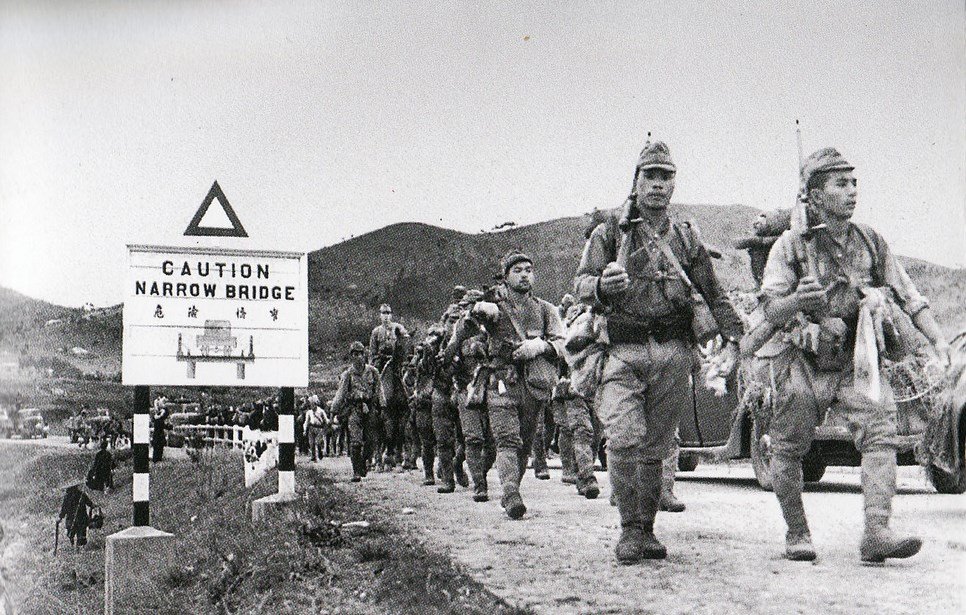
As the Japanese troops landed on the beach at Lyemun (the closest point between Kowloon on the mainland and Hong Kong island), the order was given for the Allied troops to retreat to the fort there. As dad left the trench, a mortar shell exploded close to him and tore into his leg. He collapsed, unconscious, pinned to the ground by pain and bad luck. Japanese troops advanced, bayoneting the living, stepping over the dead. My dad was mistaken for the latter and spared by incompetence.
He awoke later and crawled through the night to the hospital.
At dawn, as he emerged from the bushes, Japanese soldiers spotted him, fixed bayonets, and charged. It was to be brief and brutal, as these things tend to be.
Then a voice cut through the moment.
“Stop. Enough”.
The order came from a Japanese officer. A doctor. The same man my dad had given a lift to on that sunny Sunday when war was still only a rumour. Dad was taken inside, treated properly, and given tinned fruit, the currency of kindness in a world that had temporarily abolished it.
Months later, POW’s were ordered onto the Lisbon Maru, a ship bound for Japan. Dad was placed in cargo hold #3. Standing room only. Men knee-deep in their own waste. Rice was lowered down, eaten before it reached the edges. A floating oubliette.
Before departure, the prisoners were all brought up for a final medical inspection. Japan, meticulous as ever, did not want dysentery or any other contagious medical condition travelling towards them.
The doctor inspecting cargo hold #3 was, thankfully, the same Japanese doctor as before.
Knowing where the ship was headed, he pulled dad aside and declared him too ill to travel.
The Lisbon Maru sailed without dad. In the East China Sea – unmarked, unflagged as a POW troop carrier, it was torpedoed by a US submarine Of the 1,816 prisoners aboard, around 800 died: drowned in sealed holds or machine-gunned in the water. The Royal Artillery, trapped when a ladder failed, were last heard singing It’s a Long Way to Tipperary.
British to the end.
My dad survived 3 1/2 years in prison camp, helped because of a car breakdown, a courteous lift, occasional meetings on the golf club verandah, a mortar that prevented dad from reaching the fort, and a doctor who remembered, offering mercy disguised as bureaucracy.
Thanks to these quirks of fate, my sisters and I exist today. It’s why our children exist; why their children exist too.
Remove any one of those details and the genealogical line ends. Terminated. A small universe erased.
On another note altogether, in her early 20’s Phylipa was involved in a serious car crash. For the first few days it was touch and go, but thanks to the medical staff involved, they rebuilt her facial damage. Thankfully, she pulled through. Another instance of the precariousness of life.
Genealogy, it turns out, is a house of cards in a drafty room. Wars knock the whole table over.
So here’s my toast. Not to heroism or destiny, but to contingency. To the absurdly fragile chain of accidents that allowed you to be here today, reading this, breathing quietly, unaware of how close nothingness once came.
My congratulations. Reach over your shoulder and pat yourself on the back. You deserve it. Although my story is ostensibly for us here, somehow I feel the urge to at least acknowledge those men and women who never survived the conflict, and whose potential offspring do not walk amongst us today.
For them, we’ll never know what might have been.
Slàinte Mhath.
Graeme Dinnen
ResourcesForLife.net


Leave a Reply