
A decade or so ago, a handful of friends and I were passing a long, lazy weekend on a small island in Indonesia’s Pulau Seribu chain (Thousand Islands). Yes, it was as relaxing as it sounds – a few days of sand, salt, barbecued food and ice-cold Bintang beers.
We had taken a rattan hut for $5 a night, set a casual twenty yards from the beach and the lapping waves. The sort of place that feels as though it might at any moment be reclaimed by the tide,
On our first morning I woke at dawn, as I often do when there is nothing in particular to wake for, and padded out to the basin, positioned beneath a stand of palms.
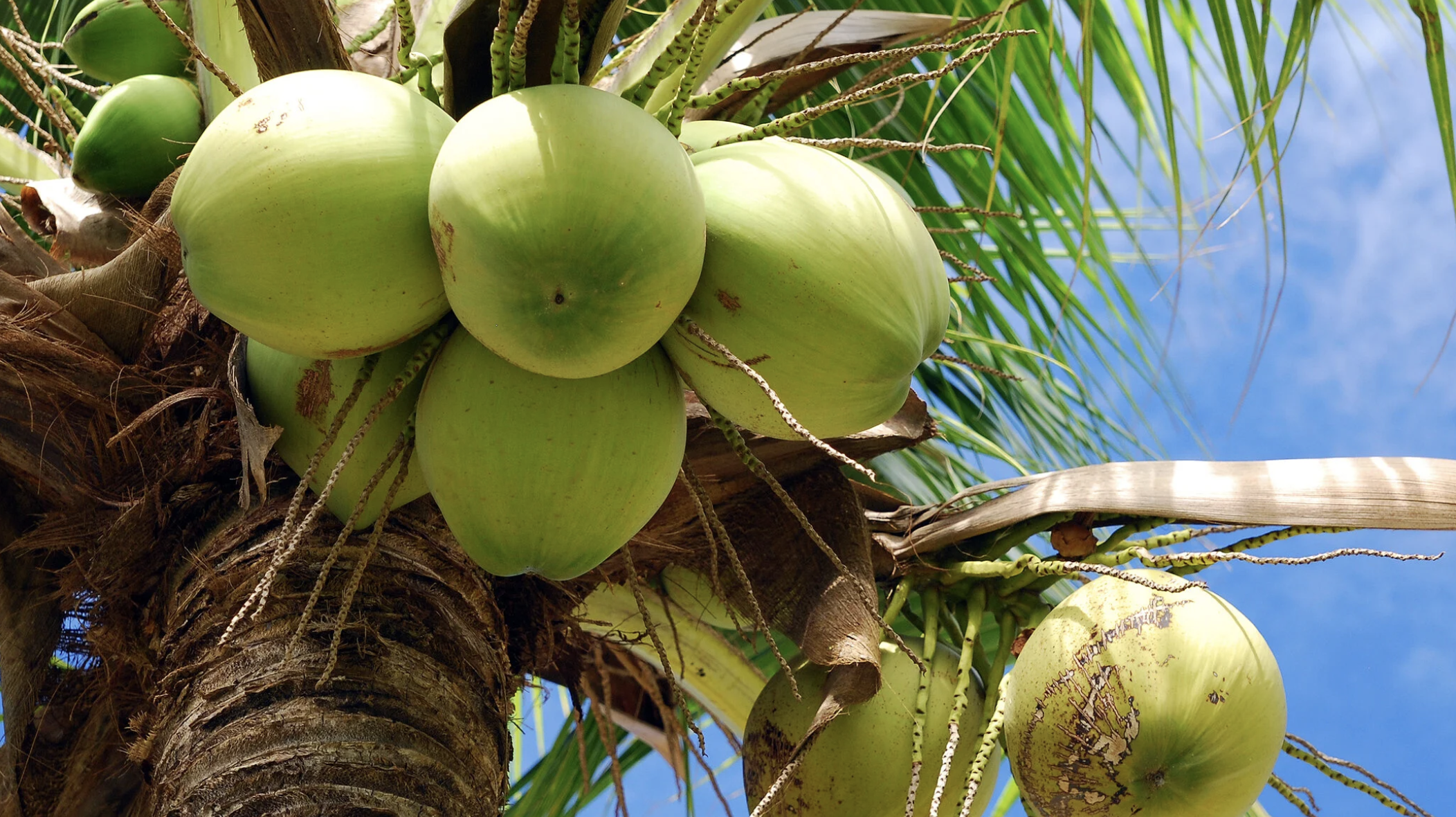
As I sluiced my face with cold water, there came an abrupt, percussive crack: a coconut, loosed from its lofty indecision, slammed into the ground beside me with the sort of authority usually reserved for small car accidents.
I’ve often heard the myth that coconuts are serial killers of the tropics. In truth, they are more negligent than homicidal, capable, certainly, of grievous insult, but rarely of outright murder.
On this occasion, I was spared both. The coconut, having made its point, lay there with a kind of dumb finality, while I wrestled with my new respect for gravity.
In my book “Spice Trails: In The Footsteps of Nutmeg and Cloves” I wrote the following:
“Coconuts, those shaggy, beach-bound bowling balls, are absurdly versatile, bordering on magical. Crack one open and you’re greeted by layers of usefulness: silky flesh, rich with tropical decadence, perfect for a piña colada or a curry that suggests far-off, sun-kissed shores.
Then there’s the milk, that luscious, ivory nectar used for drinking, cooking, and concocting elixirs worthy of Cleopatra. And don’t forget the husk – a rugged, fibrous wonder. Woven into mats, ropes, brushes, and even roofing, it’s like nature’s edible Swiss Army knife.
Coconut is the culinary chameleon. In curries, it’s pure velvet – thick and lush; in soups, like the dreamily fragrant Tom Kha Gai, it’s a creamy kiss for the palate. For desserts, coconut is pure indulgence, transforming puddings, ice cream, and flan into silk-spun sweetness.
And coconut oil? As it’s made up of mostly saturated fat, it laughs at high heat and is perfect for frying, a smoky swap for olive oil. Then there’s coconut butter, richer, almost illicit, slipping into smoothies, sauces, and dressings like pure, edible seduction.”
Let’s expand on that…..
Inside this fibrous bowling ball is a small, immaculate miracle: water that arrives pre-chilled, faintly sweet, and disarmingly pure. Coconut water has been marketed with all the zeal of a Californian wellness cult, but unlike most of their chalky, penitential concoctions, this one actually earns its halo.
Being similar in some ways to human plasma. Young coconut water is naturally sterile (inside an unopened coconut) and rich in electrolytes (potassium, sodium, etc.). Although not standard practice, in emergency situations during World War II, in tropical regions where medical supplies were scarce, doctors sometimes used sterile coconut water from young green coconuts as a temporary intravenous hydration fluid.
Coconut oil, that darling of the smugly enlightened kitchen, has been smeared onto everything from frying pans to cheekbones. It has acquired a sort of evangelical following, whispered about in the same tones once reserved for rare wines or minor deities. And while some of its claims wobble under scrutiny, it undeniably does what all good ingredients should: it makes things taste better. It lends a dish a soft, tropical hum, a suggestion of warm air and unhurried afternoons.
Then there is the flesh, which manages to be both indulgent and virtuous, a rare and uneasy alliance. Coconut meat has the creamy decadence of something that ought to come with a warning label and a side of guilt, yet it slips easily into the modern obsession with “good fats.” It is rich, yes, but not in the oppressive, button-straining way of an over-indulgent pudding.
It feels… buoyant. As if the calories have been persuaded to behave themselves.
But the true benefit of the coconut isn’t nutritional – it’s psychological. It is impossible to encounter one without entertaining, however briefly, the fantasy of elsewhere. The coconut is portable escapism. It conjures beaches you haven’t visited, breezes you haven’t earned, and a version of yourself that is considerably less burdened by inboxes and deadlines. Few foods manage to be both sustenance and daydream.
Of course, it is also absurdly impractical. Opening a coconut requires either specialised tools or a level of aggression that borders on performance art. You will spill things. You will question your life choices. But perhaps that, too, is part of its charm. The coconut resists convenience; it demands participation. In an age of frictionless consumption, there’s something faintly noble about a food that insists you work for it.
When we lived in Canggu, Bali, returning home on our scooter we’d often stop at a roadside stall to buy two coconuts. The lady there would, with years of skill, cut the coconut until it was almost open, leaving us to get back home without spilling any coconut water and leaving us to execute the last cut. Two coconuts for £0.75 pence
And then there’s the matting. Coconut matting (coir) is a durable, natural, and eco-friendly material made from coconut husks. It excels at scraping dirt and moisture from footwear, making it ideal for residential and commercial entranceways, while also serving as a biodegradable solution for soil stabilisation and slope protection in landscaping. Also for….
Gardening & Horticulture: Used as coconut liners for hanging baskets, coconut poles for supporting climbing plants, and as a biodegradable mat to protect seeds from birds and foot traffic.
Sound and Thermal Insulation: Acts as a, eco-friendly insulating material in buildings, helping to reduce noise and maintain temperatures.
Outdoor Flooring/Activities: Provides stable, temporary, or permanent paths on soft ground, beaches, and for outdoor events.
Cooking Oils
As the years have gone by, there has been increasing awareness that seed oils are not good for us, but unfortunately, even if we want to avoid them they are in almost every processed food, even infant formulas. This touches upon a longstanding observation – if something toxic is being promoted, in most cases, regardless of how much the public protests against its use, the only way it ever gets phased out is if a less toxic substitute is found for it.
As such, I’ve put a lot of thought into which oils could replace the high omega 6 oils we routinely use . If we look at it from a standpoint of omega 6 content and omega 3 content, the following options exist:
Coconut oil has gained a lot of attention for both health and lifestyle uses. With a smoke point of 350 (virgin) or 400 (refined) and
High in saturated fat, it is not a superfood cure-all despite the hype, and is best used as part of a varied diet, not the predominant fat source.
So yes, the coconut is good for you – hydrating, nourishing, and faintly medicinal. But more importantly, it is good for your imagination. And that, in the end, may be the most restorative property of all.
Graeme Dinnen
ResourcesForLife.net

Unlike other trees, the palm tree leans towards the prevailing wind

Leave a Reply