
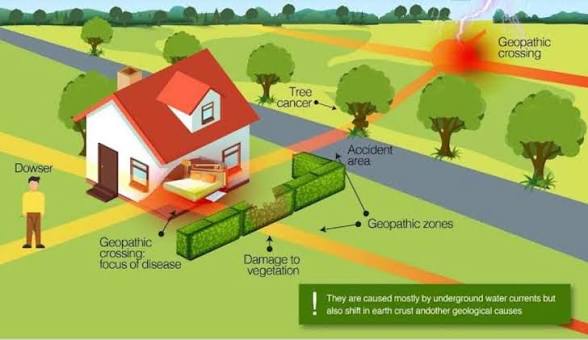
There are places that simply feel right. You walk through the front door and your shoulders loosen before you’ve even put the kettle on. Others, despite polished kitchens and estate-agent promises, never quite become home.
Advocates of Geopathic Stress believe the difference lies beneath our feet.
The theory is beguilingly simple. Invisible natural energies, created by underground watercourses and geological faults, may subtly influence our wellbeing. Sleep, they suggest, can become deeper, moods lighter, relationships calmer and concentration sharper when we are living or working in harmony with these natural forces.
Supporters point to countless observations gathered over decades. Dowsers speak of homes transformed after nothing more dramatic than moving a bed a metre or two. Animals often seem to know instinctively where these energies lie; dogs may avoid them while cats appear strangely attracted. Trees sometimes twist to escape them, bees abandon affected hives, and even babies, too young to understand, are said to shuffle towards more comfortable sleeping positions.
In parts of Europe, the idea has been taken seriously enough for builders to consult dowsers before construction, aiming to create homes where every room rests on balanced ground. It is an approach that sees a house not merely as bricks and mortar, but as an environment that should nurture the people within it.
Science has yet to provide a universally accepted explanation for geopathic stress, but its supporters argue that absence of proof is not proof of absence. They see it as another reminder that nature is infinitely more complex than our current understanding allows.
Whether one views geopathic stress as emerging science, ancient wisdom or simply an invitation to observe the world more carefully, it encourages us to think differently about the places we choose to live. After all, home should be more than a roof over our heads – it should be a place where body, mind and earth exist in quiet harmony.
Linda was twelve when she developed leukaemia.
There followed the modern catalogue of medical misery: a bone-marrow transplant, chemotherapy, radiotherapy and a month spent in isolation, away from the ordinary world of childhood. Eventually she began to recover and went home. She slept in her mother’s bed.
And something rather curious happened.
Week by week, Linda got better.
Then she was well enough to return to her own bedroom, to her own bed. And the leukaemia returned.
Her mother had never heard of geopathic stress. She had no particular theory about it and, understandably, was prepared to try almost anything that might help her daughter.
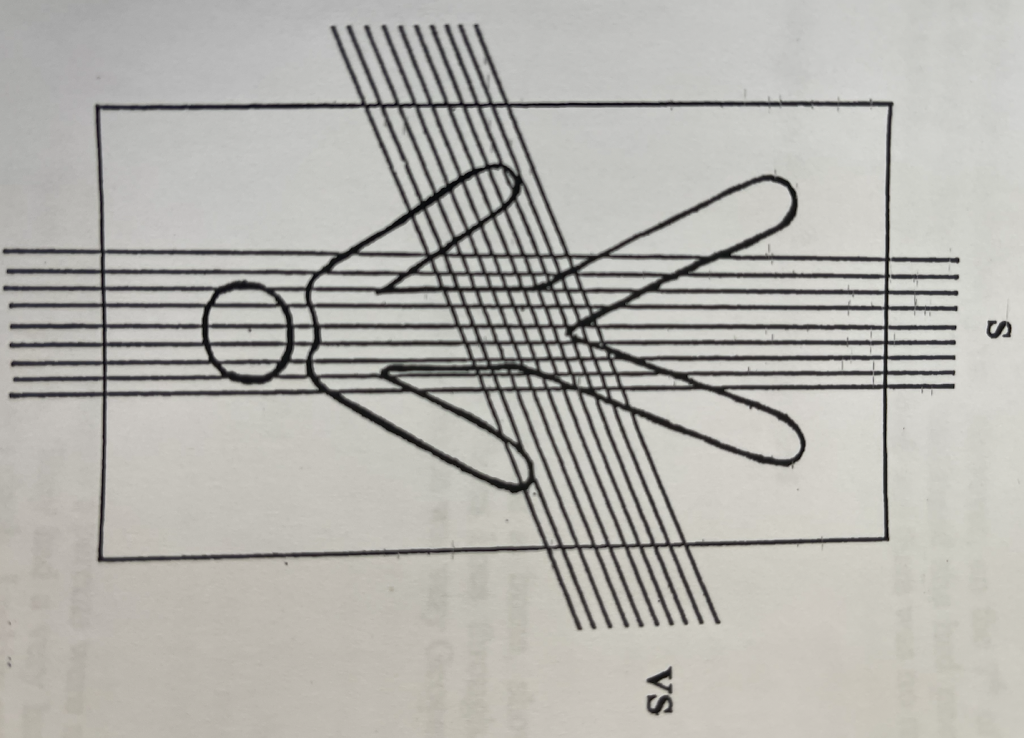
A dowsing investigation was carried out. Two geopathic-stress lines were identified running beneath Linda’s bed — one described as strong, the other very strong.
So they moved the bed.
Within a month, Linda’s hospital decided that no further treatment was required.
She recovered.
Now, whether you regard that as coincidence, curious circumstance or evidence of something we don’t yet properly understand is, of course, up to you. But it is an intriguing story, and perhaps that is enough reason to ask questions.
Linda’s bed position showing geopathic stress lines: (S = strong and VS = very strong)
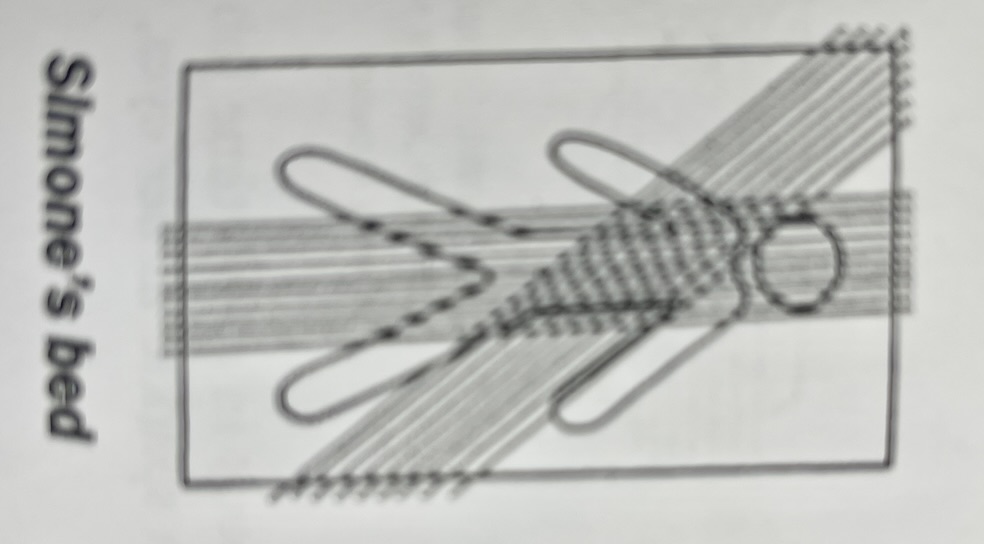
Then there was Simone. She was only nine when she developed a cancerous tumour and underwent six sessions of chemotherapy. Then came the high temperatures, the loss of her hair, a bone-marrow transplant, swollen cheeks and feeding through a tube into her stomach.
Eventually, her family were told that the cancer had gone.
It hadn’t.
The cancer returned, followed by pneumonia. Simone died in 2001. Unfortunately SImone’s parents had not been told about GS and they had a hard time getting over their daughter’s death.
Two children. Two very different endings. And between them sits a question that conventional medicine doesn’t necessarily ask: could the environment in which we sleep, live and recover have an influence on us?
Geopathic stress is the name given to the idea that natural underground features, geological formations and certain environmental fields can create areas of disturbance – particularly where we spend many hours in one place.
It can affect sleep, wellbeing and health. Claims have been made linking it to everything from restless babies and bed-wetting to learning difficulties, epilepsy and unexplained health problems.
Some practitioners even suggest that babies instinctively move towards the least-stressed part of a cot.
These are still considered to be controversial claims, but curiosity should never be forbidden simply because the answer isn’t yet convenient.
The bedroom is a particularly interesting place to begin.
We spend roughly a third of our lives there. We don’t move while we’re asleep. We don’t choose where our bodies are positioned during those hours. The bed becomes, quite literally, our most sustained relationship with a particular piece of ground.
So perhaps there is a simple principle worth adopting:
Don’t believe everything. Don’t dismiss everything. Investigate.
If you’re moving house/flat, why not look at the environment before you sign anything?
Consider the geology. Consider external sources of radiation and electromagnetic exposure. Consider where you sleep. And, if geopathic stress concerns you, have the property assessed by someone experienced and sensible rather than someone determined to frighten you.
You don’t have to become a believer. Just a detective.
Because sometimes the most useful question isn’t “Do I believe this?”
It’s: “What happens if I look?”
And that, ultimately, is what being your own detective means.
Geopathic Stress can impact so many activities both inside and outside the house. It is even estimated that 25% of people diagnosed as epileptic are wrongly diagnosed and the main cause of the symptoms is Geopathic Stress.
Pregnancy, Sudden Infant Syndrome (Cot Death), excess bed wetting, learning difficulties, seemingly unrelated health challenges, even car accidents can be affected by the incidence of Geopathic Stress
Before you relocate to a new home it is essential to have your new place checked out for GS lines as well as the impact of radiation from external sources by someone who knows what they’re doing. If you need help with this, please contact me.
Become Your Own Detective
You can buy a copy of Rolf Gordon’s book “Are You Sleeping In A Safe Place?” from Dulwich Health or your local Amazon.
Graeme Dinnen
ResourcesForLife.net
Leave a Reply