
When I was 10 years old, at a boarding school in Scotland, we’d have letter-writing on Sundays. You know those letters to parents that usually started “Dear Mum and Dad, Hi. How’s the weather? Hope you are well”
We even had handwriting competitions. I never won.
30 years ago, I was invited to join the Hong Kong office of a blue-blooded London merchant bank. Part of the recruitment process was a handwriting analysis. My handwriting revealed that I was under a considerable amount of stress.
My new management knew this anyway and told me that if the analysis hadn’t evidenced this, they would have been suspicious of its value. I got the job, and to celebrate, I bought myself a Montblanc pen, which I still use today
– – – – –
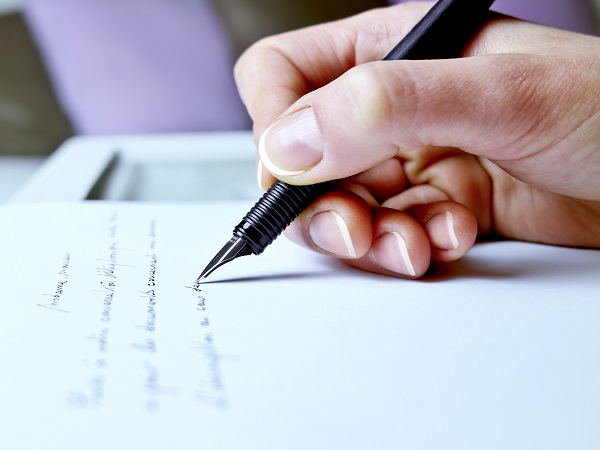
Put down your phone or laptop. Step away from the glass altar of efficiency. Pick up or buy an ink pen, (not a biro) that faintly grubby relic from the age when thinking required friction.
Science, bless it, has finally caught up with common sense. Writing by hand, it turns out, makes you cleverer than typing. Not wiser, not kinder – just better at remembering things, which is often the same thing.
When pen meets paper, the brain throws a small party. Motor skills, vision, language – all turn up, sleeves rolled, ready to work. The neuroscientists call this an “encoding effect,” which sounds dull but behaves like a minor miracle.
Handwriting is muscular thinking. Each letter is made, not summoned. The brain has to negotiate shape, pressure, movement. It leaves a trail, a proper footprint, rather than a smear of pixels that vanishes the moment you look away.
Typing, by contrast, is thought-lite. The fingers tap obediently on identical keys, like trained pigeons. The brain barely breaks a sweat. It records less because it does less. Efficient, yes, but so is instant coffee, and no one pretends that’s memorable.
So when you’re planning the week, assembling the grocery list, or trying to remember what the children need for summer camp (everything, as it happens), resist the phone. Use paper. Write badly. Scribble. Cross things out.
Your brain likes a bit of resistance. It remembers effort. And it will repay you, not with notifications, but with recall.
– – – – –
Some background info:
• In 2011, Dr. Hiroshi Tanaka began following 300 people who had somehow reached their eighties without their brains deciding to pack up and leave. For eight years he watched them, expecting to discover some exotic genetic blessing or a diet involving fermented roots and mountain herbs. Instead, he found something disappointingly ordinary. Every one of them spent about fifteen minutes a day writing by hand. Not pecking at a keyboard. Not poking a screen. A pen. A piece of paper. Civilisation’s oldest operating system.
• Brain scans suggested there was more going on than nostalgia. Handwriting turns out to be a surprisingly busy occupation. It recruits motor control, spatial awareness, language, memory – whole districts of the cerebral city light up at once. Typing, by comparison, is closer to a conveyor belt. Efficient, repetitive, and only intermittently inhabited by thought. The fingers remember the movement; the brain can sometimes be excused from attending.
• Tanaka decided to test the idea. He recruited 120 adults between 65 and 75 who were beginning to notice the small indignities of memory decline. Half spent fifteen minutes a day writing by hand. The others typed. Six months later, the scribblers performed better on recall tests and processed information more quickly. The act of writing appeared to do more than record thoughts. It seemed to strengthen the machinery that stores them.
• At this point the story usually acquires a villain, and here one arrives on cue. According to later accounts, pharmaceutical executives worried that enthusiasm for non-drug interventions might be awkward for the business of selling drugs. Handwriting, after all, has the commercial disadvantage of being impossible to patent. A fountain pen is a terrible recurring revenue model. Writing didn’t just store thoughts. It reinforced the neural structure that holds them. Whether this amounted to suppression or merely corporate indifference depends on how generously one feels towards boardrooms.
• Most people regard memory loss as a sort of meteorological event: regrettable, inevitable, and best endured while waiting for someone in a white coat to invent a solution. Others take the less fashionable view that the brain resembles a muscle more than a museum piece. Leave it idle and it weakens; use it and it adapts. Fifteen minutes a day with a notebook may not confer immortality, but it is certainly cheaper than a prescription and rather more pleasant than dementia. The question is whether you prefer maintenance or repair.
– – – – –
Handwriting has become an eccentricity. We no longer write; we peck. Our thoughts arrive in the world via thumbs, autocorrected, sanitised, stripped of accent and attitude. Typing is efficient, but efficiency is rarely where the soul hangs out.
Put a pen in someone’s hand and something peculiar happens. The mind slows to the speed of the body. Thoughts, which usually career about like greyhounds on amphetamines, are forced into a dignified walk. Handwriting is stubbornly physical. It asks the wrist, the fingers, the shoulder to participate. It insists on presence. You cannot dissociate while looping an “l”.
Also, it leaves evidence. Proof that you were here, that you felt something, that you took the time to shape it into words. In an age of vanishing text and disposable thought, that may be the most therapeutic thing of all.
Graeme DInnen
ResourcesForLife.net


Leave a Reply