
‘Two languages in one head? No-one can live at that speed! Good Lord, man, you’re asking the impossible.’
‘But the Dutch speak four languages and they smoke marijuana’.
‘Yes, but that’s cheating.’ Eddie Izard. Dressed To Kill
– – – – –
I’ve always admired people who speak foreign languages fluently.
Probably because I don’t.
When my parents retired to the Algarve in Portugal, I made a stab at Portuguese. I managed the present tense and most of the menus. I’d go out at night with the local sardine fishing boats and my words, learned from the fishermen, were delivered with a clipped Algarve accent.
When I caught a fish, they enthusiastically exclaimed “Chova! Chova”! My reply was that it isn’t likely to rain (”Chuva”) for another few months. They were saying ‘Anchova’– anchovy. Portuguese grammar, however, is a sort of vindictive algebra dreamt up by people with a grudge.
In my defence it was a very large anchovy!
In Hamburg, I acquired a kind of beerhall German, enough to order food, lose at chess and apologise to my landlady for the rent being overdue, again.
And in Bali, I picked up Bahasa Indonesia, which is delightfully straightforward. Unlike the English language, Indonesian grammar is simple. Verbs don’t have complex conjugations. Instead, there are prefixes and suffixes. The language is essentially in the present tense and you just add ‘yesterday’ or ‘tomorrow’.
Cantonese is a language forged by dragons and spoken with a musician’s ear. I write that as one word can be pronounced in up to 9 different ways. I once tried to chat up a lovely Chinese girl with what I thought was a poetic compliment: “Your eyes are like the evening stars.” She looked confused. Then offended. Then left. Apparently, I’d told her she had eyes like a butcher.
Learning a foreign language offers range of health benefits, particularly for the brain.
- Improves memory and problem solving skils.
- Boosts your ability to switch between tasks or thoughts.
- Delays Cognitive Decline (vital these days!)
- Strengthens neural connections and creates new ones, making your brain more adaptable
- Improves Attention and Focus.
- Boosts self-esteem; reduces anxiety or depression
…….and of course a vast world of job opportunities
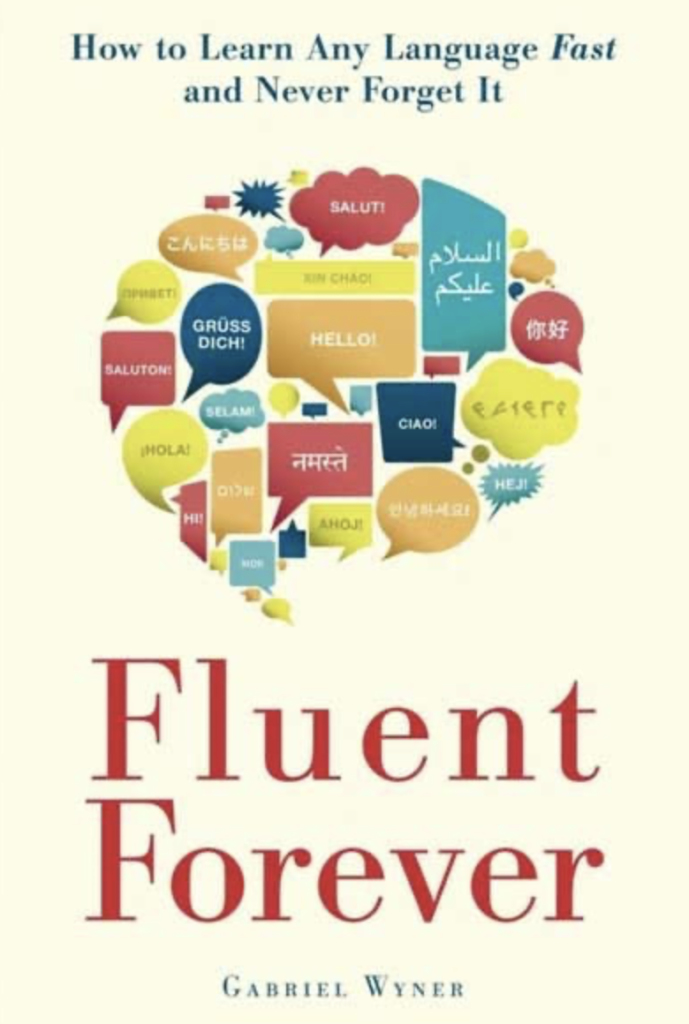
Last week I came across Gabriel Wyner, an opera singer who, seemingly tired of dying loudly in other languages, turned his formidable lungs to the sweaty business of actually learning them.
In Fluent Forever, he promotes a system of language acquisition that feels less like a classroom exercise and more like equal parts neuroscience, psychology, and the desperate improvisations of a man who once had to learn Hungarian fast.
Let’s start with French. In Wyner’s method, there are no tenses marched out like Napoleonic battalions, no sadistic verb tables flicked at your knuckles by the ghost of your Year 9 teacher. No. Wyner’s method is alarmingly reasonable: he suggests we start with the sounds.
Not vocabulary, not grammar but sounds. As in: what the language feels like before it’s sullied by spelling. It’s about learning to hear before you pretend to understand.
Then he commits outright heresy: no translation. Forget the plodding equivalencies. “Gato” doesn’t mean “cat”, it is a cat. A real one. Fur, whiskers, disdainful glare and all. Language, he insists, should be tied not to English, but to the raw and rude theatre of imagery and memory.
You don’t learn words; you summon them.
To this he adds a dose of algorithmic voodoo: spaced repetition. A gloriously dull phrase for a truly cunning idea, that your brain is most receptive to learning just before it forgets. So you trick it. You remind yourself of things precisely when they’re on the brink of oblivion. Like calling your mother.
And lastly, he demands sentiment. Real, fleshy, personal sentiment. Every word should hook itself into the soft meat of your life. When you learn “grand-mère”, you don’t just think “grandmother”, you think your grandmother, her perfume, her biscuits, the way she said your name like it was both a gift and a complaint.
In short, Wyner doesn’t teach you a language. He invites you to seduce it – to let it crawl into your head and stay there, whispering.
I spent several years in the school Language Laboratory (the “lingo labs”) speaking French into large microphones linked up with reel-to-reel tapes.
Do I speak French? Not a chance.
To learn a language there must be an strong underlying reason. Living in that country, meeting a beautiful Italian lass (or handsome guy) that doesn’t speak English and you want to get to know better.
One British linguist learned a European language every year by arranging to journey through a remote area in that country at the end of the year. His ability to survive depended on his command of that language.
That’s a pretty good reason.
A contribution to my grandchildren learning foreign languages will be Wyner’s book ‘Fluent Forever‘ together with a brilliant approach to learning and retaining information – ‘Memory Craft‘, in which Lynne Kelly explores ancient mnemonic techniques and how they can boost modern memory.
Drawing from Indigenous knowledge systems and her own experiments, she demonstrates how physical spaces, storytelling, and creative associations help retain vast information.
Her book bridges history, neuroscience, and personal development with practical, engaging insights.
Given that the education system is designed to weed out those who act independently, this approach sounds better than years in school already!
Graeme Dinnen
ResourcesForLife.net
Leave a Reply