
The River of Life
For many years, Phylipa and I have opted for an annual live blood analysis.
What’s the purpose of our blood? In the words of Professor Keith Scott-Mumby: “Your blood’s entire job is to transport substances quickly and efficiently.”
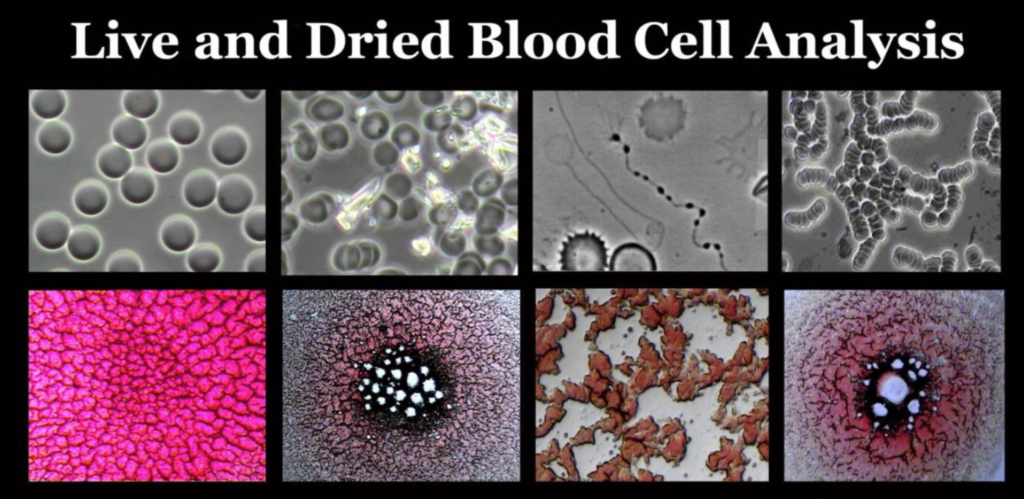
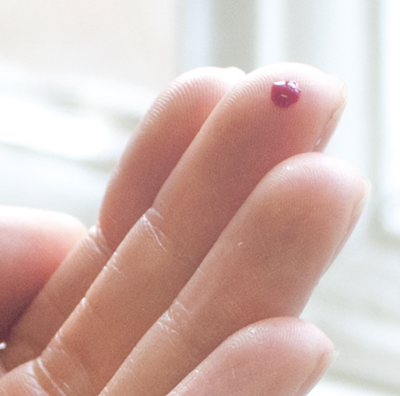
It begins with a gentle stab of the finger from which emerges a bead of blood. That droplet is then ceremoniously smeared onto a glass slide and squashed under the stern lens of an electron microscope, at which point it transforms into something far grander than its origins: your inner cosmos laid bare in plasma, an entire galaxy unfolding.
This is live blood analysis, or LBA if you prefer acronyms and mystery. It is diagnostic theatre meets alchemy, a performance in which your blood becomes the main character in a tragicomedy of nutritional neglect, fungal invasion, and possibly, God forbid, candida.
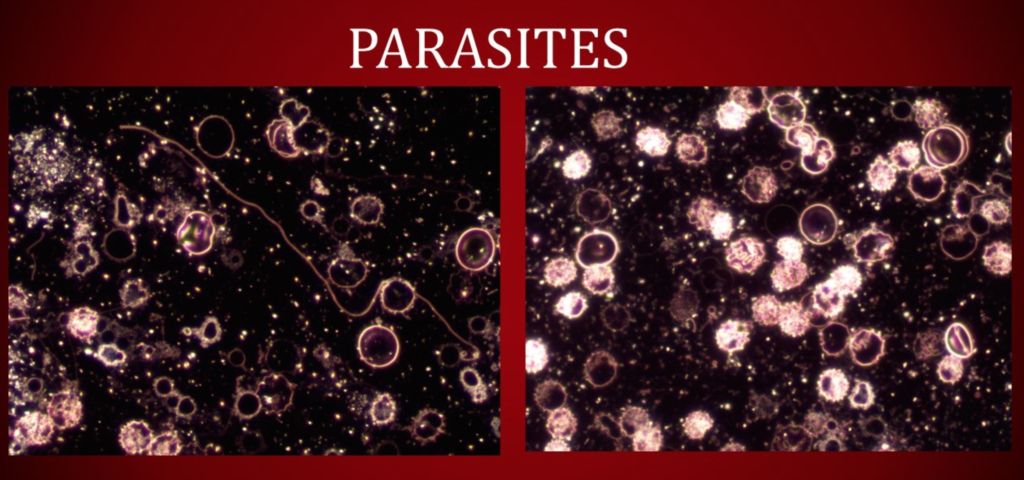
Sparkling with fields of quantum dots, iridescent fibres, unnatural hydrogels, microchip-like shapes, unnatural technologies and filaments, either ingested or injected.
The practitioner will point at your plasma as if it were a crime scene. “See that?” they’ll say, gesturing at a dark red blob. “That’s evidence of oxidative stress, or that’s parasites, or that’s crystals forming, or your red blood cells are clumping together”.
You nod, sagely.
But what, precisely, are the benefits of this glorified presentation on your haemoglobin?
Let’s begin with the obvious: visibility. Live blood analysis lets you see your blood. It’s your body, in motion, not some sterile number on a printout created days after your blood was taken at the doctors surgery.
It’s intoxicating, like watching your own CCTV footage in real time. And in a world where medicine increasingly resembles an online bank statement (cryptic, impersonal, and not nearly as flush as you’d hoped), this is visceral, immediate, intimate.
It’s the biological equivalent of looking someone in the eye and asking, “What are you not telling me?”
Next, there’s the accountability. You can’t argue with a squashed cell under a microscope. Your blood, when displayed like a Damien Hirst installation, becomes the ultimate guilt trip. Those late-night kebabs, those 17 oat milk lattes, the supplements you never took, they all seem to bob to the surface like regrets in a confessional.
LBA has a way of shaming you into better habits, not through science, but through showmanship. It’s nutrition via noir.
There is, too, the empowerment. For those cast out into the shadowy margins of mainstream medicine, the chronically tired, the always-bloated, the ones told it’s “probably stress”, LBA offers validation.
You aren’t mad. You aren’t lazy. Your blood is telling a tale of systemic neglect, fungal overgrowth, and perhaps the fact that your pancreas is on strike. It’s the sort of story your GP has neither the time nor the inclination to listen to.
Let’s not forget the theatre. Medicine, at its best, is performance. The starched white coats, the jargon, the ritual humiliation of stepping on a scale. LBA has all this, but with the added sparkle of mysticism. It’s what happens when healthcare gets a Goop subscription. You’re not a patient, you’re a pilgrim.
Of course, critics, drab men in grey suits with letters after their names, will scoff. They call it pseudoscience, snake oil with a microscope. And yes, if you press too hard, the edifice wobbles.
They’re after a welterweight of peer-reviewed proof. Diagnoses can vary wildly depending on who’s interpreting the images And one person’s “fibrin strand” is another’s “overactive imagination.”
But that’s missing the point. Live blood analysis isn’t about accuracy, it’s about attention. It’s a 45-minute homage to you, your body, your chaos. When was the last time the NHS did that without a tiresome waiting list?
So yes, have your blood examined. Marvel at your misshapen cells, your clumping platelets, your sticky rouleaux. Feel shame. Feel fascination. Feel something. Because sometimes, health isn’t about medicine. It’s about being seen.
Even if it’s just under a microscope.
The net result will provide your body with the nutrients and vitamins it needs to function in tip-top shape. However if your blood is thick and moves like molasses, it can induce a whole host of problems such as a heart attack, dementia, stroke and cancer.
You need free-flowing blood to make sure your heart, brain and other organs are getting the FULL benefit of any supplements you take as well as nutrients from the good, clean food you eat.
All so you can stay active and healthy, no matter your age. But know that you’re as old as your arteries, rather than the number of candles on your birthday cake.
While we’d opt for LBA every time I have to conclude by stating that Live Blood Analysis is not recognised or recommended by NHS or mainstream medical professionals in the UK due to its (theoretical) lack of scientific basis and risk of misinformation and that standard blood tests ordered by a GP are promoted as reliable, evidence-based, and critical tools in the diagnosis and monitoring of health conditions.
The choice, as always is yours. I know mine.
Graeme Dinnen
ResourcesForLife.net
Leave a Reply