
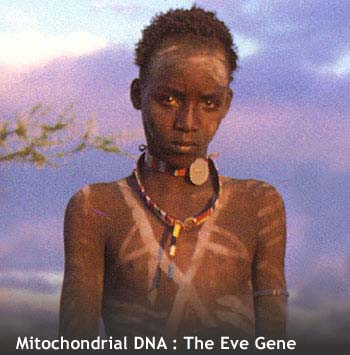
Once upon a very long time ago, in the dusty cradle of what we now call East Africa, a woman walked. She was, in all likelihood, unaware that she would one day be given the grand, almost biblical title of Mitochondrial Eve.
She wasn’t the first woman, not by a long shot, and she certainly wasn’t the only one. But she was the one who got lucky in the genetic relay race, the matriarch whose mitochondrial DNA has been passed down, unbroken, to every single one of us.
Yes, all of us. You, me, all the Popes, Taylor Swift’s boyfriend before last, David Beckham, that nice man at the bus stop, the bloke who cut you off in traffic – we all come from her.

This startling fact emerged from a decade-long DNA project by National Geographic, an ambitious scientific rummage sale that sifted through the genetic heirlooms of humanity, collecting samples from the jungles of Papua New Guinea, the rolling Tuscan hills, the frozen vastness of Siberia, the sprawl of China, the wilds of Kenya, the pubs of Dublin, the fjords of Iceland, and every conceivable village, city, and forgotten backwater in between.
The results were both groundbreaking and deeply inconvenient to those who prefer their ancestry with a side of selective amnesia. Because, as it turns out, the great-grandmother of all humanity was an East African nomad. She was, in all likelihood, black.
Her descendants – our forebears – wandered north and south and east and west, their bodies gradually adapting to ice and sun, jungle and steppe, through the slow, patient chisel of natural selection. Over thousands of generations, some of them turned pale, some of them kept their rich dark skin, some of them developed blue eyes, and some of them folded themselves into the genetic mosaics that became the human race as we know it.
The human race differentiates itself in several complex and interrelated ways, which can include factors like race, ethnicity, culture, religion, gender, and social class. These distinctions are often used to define group identities, but unfortunately, they also led to prejudice, discrimination, and divisiveness.
Of all the lazy, racially charged clichés smuggled into public consciousness, few are as absurdly wrongheaded as those heaped upon the Neanderthal. Note the phrasing – human race – not some distant evolutionary side-hustle or primitive cousin twice removed.
If modern humans, scattered across continents, carry a solid percentage of their genetic legacy, then Neanderthals never vanished at all. Extinct? Hardly. Their story isn’t one of disappearance, but of absorption. They had a far longer tenure on this planet than we have managed so far, and when their chapter came to an end, they didn’t all die – they simply became us.
Now, this is the part where people get uncomfortable. Tell someone they are related to a medieval king, and they’ll puff up with the warm glow of imagined nobility. Tell them their ultimate ancestor was a black woman in Africa, and watch their face crumple like a disappointed soufflé.
The usual conversation goes something like this…..
“We all come from an East African nomad woman?” they ask, incredulously.
“Yes.” I reply
“And she was black?”
Yes.”
“Well, I don’t believe that.”
But science, unlike politics or wishful thinking, is not a buffet – you don’t get to pick the facts that suit your palate. The truth, inconvenient as it may be, is that we are all cousins, some many times removed, but family nonetheless.
The distinctions we draw – race, nation, tribe, faith, football team – are little more than genealogical footnotes, the petulant scribblings of people who have forgotten the first rule of ancestry: everyone’s got one.
So on Mother’s Day, (30 March in the UK; 11 May elsewhere) let’s raise a glass to all our mothers – the ones we know, the ones we never met, and the one we all share, the mother of seven thousand generations.
Mitochondrial Eve, who walked the land long before we carved borders into it, who carried the future in her bones, who never could have imagined what a complicated, feuding, wonderful mess her children would become.
Clink of champagne glasses……“Thanks Mum”.
Graeme Dinnen
ResourcesForLife.net
Leave a Reply