
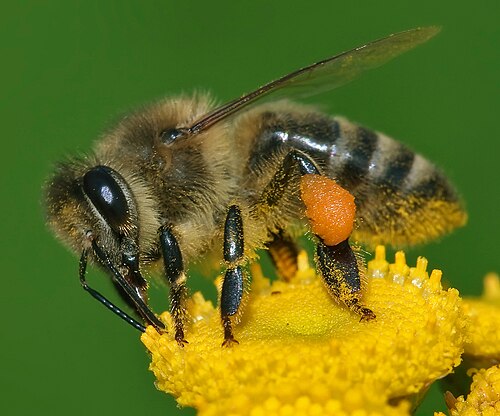
Bees are furious, overworked, and holding civilisation together with borrowed time and borrowed pollen.
They’re having a difficult century. Not in the manner of Russians or smokers or middle-aged men trying to understand oat milk, but in the way tiny, industrious creatures do: quietly, catastrophically, and mostly beneath our notice – until a supermarket shelf looks barren and a punnet of strawberries costs thrice what it costs today.
We are informed, usually by people carrying clipboards made of recycled yoghurt, that without bees humanity would perish in four years. Many people think this is nonsense. Humanity would survive. We’d simply do it while eating fewer almonds and looking slightly peaky.
The bee has become the panda of the herbaceous border: an emblem of ecological guilt that urban liberals mention while poisoning an entire windowsill of basil through neglect.
Children are taught to save them, councils plant “pollinator corridors,” and somewhere in Shoreditch a man with a beard like damp moss is selling artisanal organic rooftop honey for the price of a kidney.
Yet bees themselves remain spectacularly uninterested in public relations. They are not noble creatures. They are airborne syringes with a work ethic bordering on Calvinist psychosis.
A bee spends its entire life in a state of caffeinated panic, ricocheting between flowers like a tiny unionised drone, before dying pointlessly in someone’s Pimm’s. There is something almost Japanese about them – a culture devoted entirely to duty, collective sacrifice, and incomprehensible dancing.
Why Today Matters
One in three mouthfuls of food you eat exists because a bee landed on a flower. Almonds, apples, avocados, blueberries, coffee. All of it. Without pollinators, the global food supply doesn’t decline, it collapses.
What We’ve Done to Deserve This
And what do we reward them with? Pesticides, habitat destruction, and fields so chemically enthusiastic they could strip paint off a trawler. Modern farming has transformed the countryside into a green desert: acres of monoculture stretching to the horizon, interrupted only by the occasional dead badger and a Range Rover doing under forty in a narrow lane.
Bees once enjoyed hedgerows, weeds, meadows – the sort of untidy fecundity the English countryside specialised in before we decided everything should resemble an accountant’s lawn.
Climate change hasn’t helped. Flowers bloom early, seasons progress through the calendar, and bees emerge expecting a banquet only to find the ecological equivalent of arriving at a wedding after the buffet’s been cleared. I can only imagine them hovering indignantly in the rain, muttering bee obscenities.
Of course, the real tragedy is that bees are among the few genuinely useful things left in modern civilisation. What they provide is miraculous: honey manufactured by insects with brains the size of punctuation marks. Compare that to humanity’s recent contributions – NFTs, podcast hosts, and watermelon-flavoured gin – and I feel the bees deserve a formal apology.
We’ve managed to industrialise flowers. That takes a particular kind of talent.
Still, we persist in discussing bees with the patronising sentimentality reserved for elderly Labradors. “Save the bees,” people cry, before paving over a garden to make room for a hot tub. If bees possessed irony, they would sting us all on principle.
Perhaps they should. The bee is not dying because nature is cruel. Nature is cruel as a matter of policy. Bees are dying because humans have turned the planet into an aggressively inconvenient place to be alive.
And yet they continue. Against reason, chemistry, and the full imaginative bankruptcy of modern agriculture, bees still stagger drunkenly from blossom to blossom, performing the invisible labour that keeps strawberries cheerful and humanity vaguely fed. There’s something heroic in that. Or perhaps merely tragic.
The Most Dramatic Insect in the Garden
The honey bee carries within her the most melodramatic exit strategy in the insect world. She stings once, and pays for the impertinence with her life. The sting is barbed, like some medieval fishing hook, and when she attempts to disengage from your sweaty pink flesh, she leaves behind not merely the weapon but half her internal plumbing.
Your response is to shout “Ouch!” while her abdomen is torn open, and in the sort of operatic self-sacrifice usually reserved for Wagnerian sopranos, she dies.
Other bees are less theatrical. Carpenter bees and bumble bees come equipped with smooth stingers: elegant little rapiers rather than suicidal harpoons. They can sting repeatedly without so much as mussing their velvet jackets, treating violence with the breezy professionalism of seasoned nightclub bouncers.
Worth Watching: “My Garden of a Thousand Bees”
Wildlife film-maker Martin Dohrn spent an entire summer in his Bristol garden filming its 50+ bee species in extraordinary close-up. The result is one of the most quietly compelling nature documentaries in years. If it moves you, here’s something practical you can do afterwards.
If you feel a faint moral wobble about the insect body count you’ve amassed over the years – the squashed scouts on windscreens, the rolled-up-newspaper executions, the casual domestic pogroms – here is your chance at karmic bookkeeping. Save a few bees. Plant something sticky and fragrant. Leave them to their small, drunken industry. You may even find yourself sleeping more soundly, untroubled by the ghostly buzz of accumulated apian manslaughter.
Found a Bee That Can’t Fly? You Can Save It.
The Bee Revival Kit from Just Bee Honey lets you revive a grounded or exhausted bee in minutes, and it’s half price for World Bee Day. Ships across the UK. Get the Bee Revival Kit — 50% Off . And genuinely, there is limited availability.
Here are some fun facts about these amazing insects:
• The honey bee has FIVE eyes, two large compound eyes and three smaller ocelli eyes in the centre of its head. The ocelli can detect the transition from darkness to light. They use them to detect where the horizon is.
• Bees can fly up to 20 mph
• The Queen bee lays up to 2,500 eggs a day!
• To make 1 lb. of honey, bees must collect nectar from 2,000,000 flowers!
• Honey bees do not die out over the winter. They feed on the honey they collected during the warmer months and patiently wait for spring. They form a tight cluster in their hive to keep themselves and the queen warm.
• Bees use the position of the sun to navigate. Bees’ eyes are sensitive to polarized light, which penetrates through even thick clouds, so bees are able to ‘see’ the sun in poor weather.
• Honey bees are one of science’s great mysteries because they have remained unchanged for 20 million years, even though the world has changed around them.
They need all the help we can give them.
Graeme Dinnen
ResourcesForLife.net
PS. Beekeeping 101 is the sort of summer diversion that begins as a wholesome parental fantasy and ends with the children speaking in hushed reverence about brood frames and pollen baskets while you stand in the garden dressed like a forest dweller. If your ambition is to prise them from the blue narcotic glow of screens, this will do it splendidly. Bees, unlike TikTok, are good company.
I’m not entirely sure if this’ll work for you, but use the coupon code GRAEME and with luck you’ll get 20% off.
What starts as a mild pastoral experiment soon acquires the intoxicating gravity of a minor religion. Best of all, the bees repay your meddling with jars of honey so indecently golden and fragrant that supermarket squeezy bottles begin to taste like axle grease.
And then there are the children themselves, transformed from thumb-flicking digital molluscs into wide-eyed acolytes of the hive, peering into frames with the solemn concentration usually reserved for neurosurgery or Minecraft. You may even discover that one of them develops an actual passion for it.


Leave a Reply