
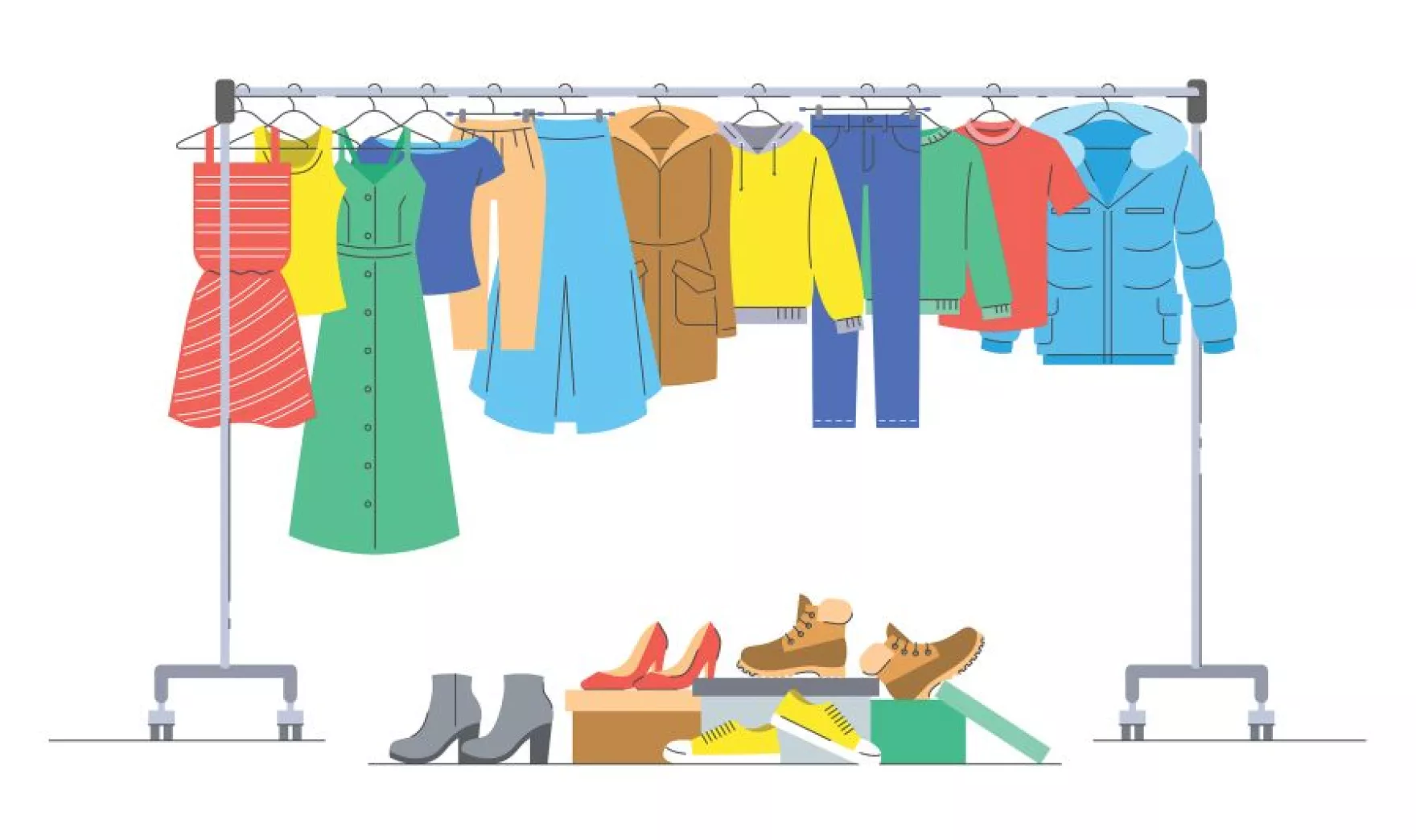
In the parlours of holistic wellness, there persists the belief that fabrics possess their own frequencies. The notion goes that every textile hums away at its own spiritual megahertz: linen and wool apparently crackle at an impressive 5,000 Hz, organic cotton murmurs somewhere near the healthy human body, while polyester skulks around at the energetic equivalent of a Wetherspoons at closing time.
This doctrine, stitched together from bioenergetics and conscious fashion, leans heavily on the work of Dr Heidi Yellen, who in 2003 produced findings now quoted with reverence in wellness circles.
According to Yellen, linen and wool elevate the body’s energy field, organic cotton keeps us spiritually tuned-up, and synthetics such as nylon and rayon sap vitality like emotional vampires in leisurewear.
Naturally, this all comes wrapped in the remnants of ancient wisdom. The biblical prohibition against mixing wool and linen (LEVITICUS 19:19. “Do not wear clothing woven of two kinds of material.”) is triumphantly wheeled out as evidence that Moses, somewhere between the commandments and the smiting, had a working grasp of textile energetics.
Some enthusiasts even claim the two fibres cancel each other out entirely when combined, producing a sort of metaphysical beige noise.
Science, these days, often told what to believe, regards the whole business with denial. Fabrics, they say, do not emit healing frequencies into the body any more than your bath towel communicates telepathically with your pancreas.
In physics, vibration refers to measurable mechanical oscillation – the dull but useful sort engineers employ to determine mass, tension and structural behaviour – not cosmic humming audible only to people who own singing bowls.
Still, the appeal is obvious. Modern life is synthetic in every sense – artificial fabrics, artificial food, artificial urgency – so the fantasy that salvation might lurk in a well-cut hemp tunic is oddly seductive. It offers the comforting illusion that wellness can be purchased not through discipline or medicine, but through superior drapery.
We know that food carries emotional and psychological energy affecting human behaviour. Quality foods uplift, comfort and energise, whereas poor quality foods drain, dull, or negatively impact mood and health.
The vibrational frequencies of clothing materials are a fascinating part of holistic health and bioenergetics, though they operate well outside of traditional empirical physics.
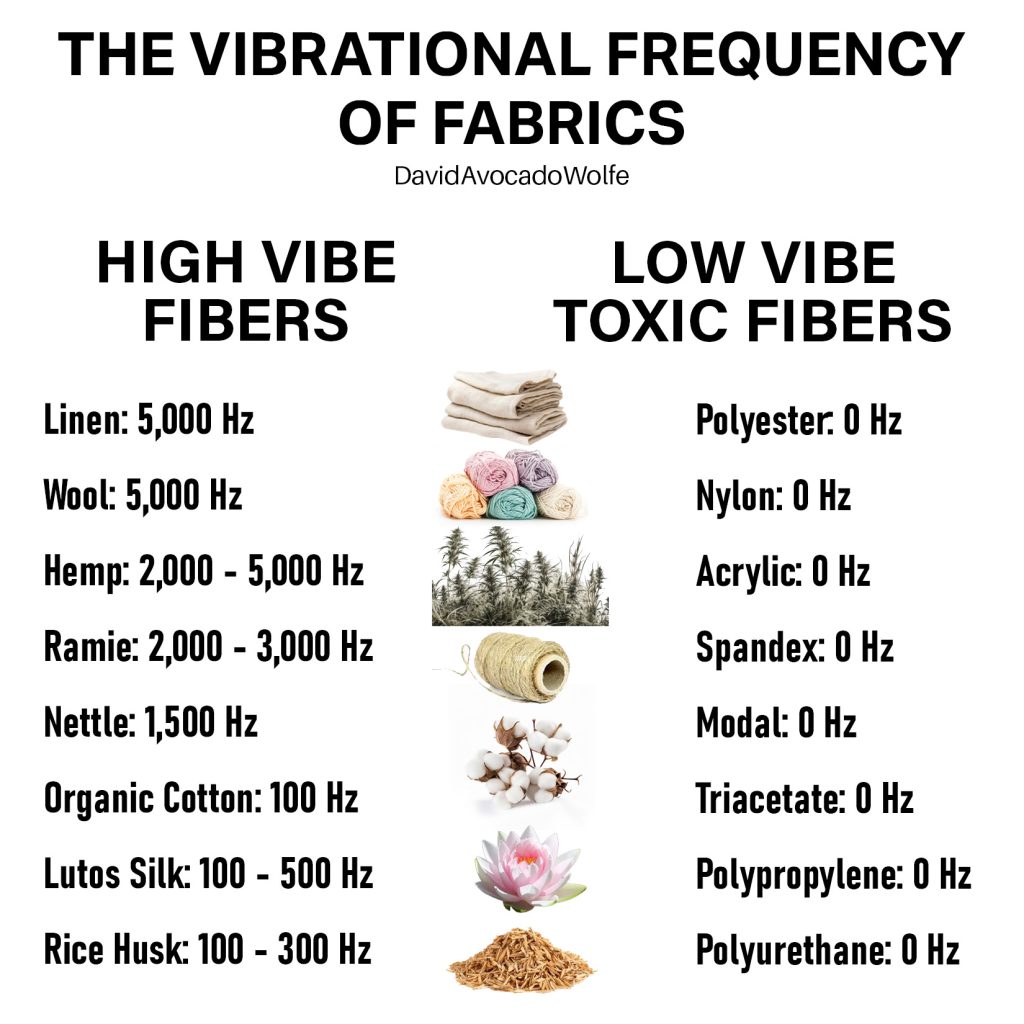
For some reason, cashmere is not listed above, but ask a search engine for its vibrational frequency and the figure of 5,000Hz is given. Alpaca wool, also omitted, is commonly believed to have a vibrational frequency between 5000Hz and 7,000Hz.
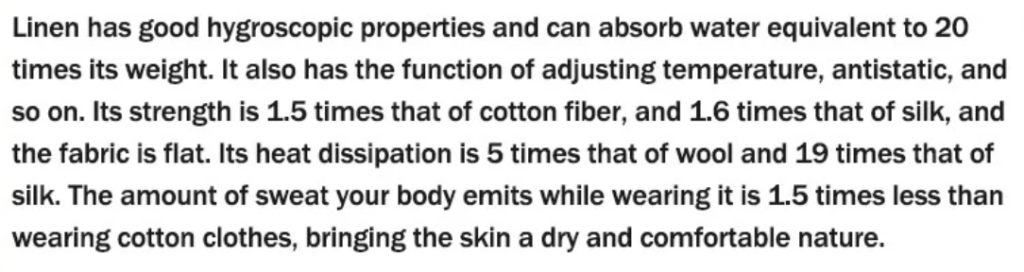
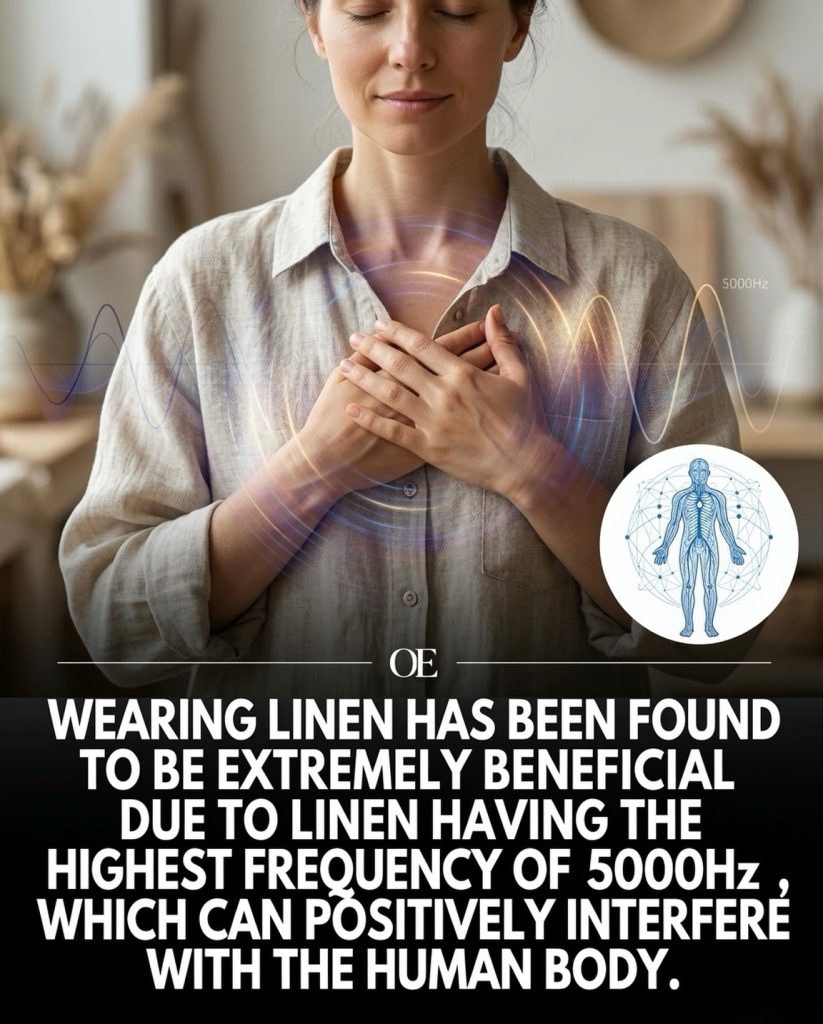
In the 1900’s hospitals used only linen sheets because they knew something we’ve forgotten – linen isn’t just a fabric – it’s healing as it emits frequencies that support the body’s recovery. Patients would heal faster just lying on it. At the cellular level, your body can absorb energy from flax linen.

Dr Otto Warburg discovered that the body vibrates at between 70-90 megahertz when it’s healthy. Chronic disease measures below 50 Megahertz, terminal illness below 15, yet linen vibrated at 5,000 Hz.
It doesn’t stop there – linen is hypoallergenic, anti-bacterial and anti-fungal, fighting off bacteria, mould and dust, also helping with allergies and sensitive skin, especially if you have trouble sleeping.
Supporting facts:
• In Japanese temples, monks spend hours smoothing fabric not because they dislike wrinkles, but because the mind syncs with the body in that moment. The hand guides the iron, the breath evens out, and without mantras to enter a meditative state. Ironing becomes attention training, which later keeps you grounded in conversations and under stress.
• Also in Japan, there is a belief that fabric holds the body’s energy. Smoothing it releases the tension left behind. You can feel it physically: rest your head on a freshly ironed pillowcase and your sleep often runs deeper. Research supports this, showing that tactile sensations from bed linens affect comfort and how quickly you fall asleep.
• Harvard studies show that rituals like ironing lower anxiety and boost performance. Repetitive actions create a meditative state, shifting the brain from anxious overdrive into calm focus. Pressed clothes give instant proof of control: you see the result immediately. When the brain sees it can handle a process, it copes better with life’s chaos.
Baby’s clothes
Most parents spend hours researching the best foods and drinks for their kids. And that’s important.
But what most parents are not doing is checking the actual fabric their baby is wearing all day. Synthetic clothing can release harmful substances like formaldehyde, and is often treated with toxic chemicals that can disrupt hormones.
Even clothes that state organic or natural on the tag can contain toxic heavy metals from the dyes and finishing agents used in manufacturing.
One study found 5 heavy metals, arsenic, cadmium, chromium, lead, and nickel, all exceeded OEKO-TEX safety limits in infant clothing samples (GOTS, bluesign, or UK/EU REACH over here)
Infants have a surface-area-to-body-weight ratio significantly higher than adults and so this is why toxic chemicals are so much more dangerous for infants than adults.
Their skin is thinner and more permeable. Their liver and detoxification systems are not yet fully developed. They absorb a dramatically higher proportion of whatever is sitting on their skin.
Cadmium exposure in infancy is directly linked to impaired neurodevelopment, lower IQ scores, ADHD, and learning disabilities in later childhood.
It stunts physical growth and increases long-term cancer risk.
For infants and young children, use GOTS-certified organic cotton (Global Organic Textile Standard) or Soil Association certification only.
Avoid any synthetic fabric, blended fabric, or anything without a legitimate third-party certification.
What may be in baby clothing (1:09) https://www.facebook.com/reel/26618673747738321
Author France Guillain, known for holistic health and lifestyle books (nutrition, baths, natural living), discussed clothing materials in a non-scientific, energetic or “vibrational” sense.
The key ideas attributed to her (and similar holistic traditions) are:
Natural fibres = “good energy”
She associated natural materials with being more “alive” or supportive of the body’s energy:
• cotton
• linen
• wool
• silk
These are seen as:
• breathable and closer to the body’s natural state
• less “disturbing” to the body’s subtle energy field
• more comfortable for long-term wear
Synthetic fibres = “bad” or draining energy
She warned against materials like:
• polyester
• nylon
• acrylic
• other petrochemical-based fabrics
In her framework, these were said to:
• “block” or disturb energy circulation
• create discomfort or imbalance
• be less compatible with the human body
And then of course there’s the subject of rubber shoes……but that’s for another time.
Graeme Dinnen
ResourcesForLife.net
PS. Many years ago, in Hong Kong, while working in the Trade Finance department of a major bank, I came across a set of documents covering the importation of clothing labels from Italy. Elegant little things they were too, each one proudly proclaiming: “Made in Italy“.
Naturally, I presumed the garment possessed some connection to Milanese craft, but no. After a little prodding, the truth emerged that the labels were indeed Italian, but they were destined to be sewn onto cotton shirts that were manufactured in Hong Kong.
And there it was – modern commerce in miniature. A shirt from Hong Kong wearing an Italian alibi. Proof, if any were needed, that what glitters in the shop window is often nothing more than clever stitching.
and more….https://www.facebook.com/reel/1380582347329644

Leave a Reply