
Could Volcanoes Trigger the Next Global Catastrophe?
Picture, if you will, me sitting on the sands of Carita Beach, West Java. The date: 27 August 1983.
We were there to acknowledge the 100th anniversary of an infamous volcanic eruption, and Bloody Marys seemed to be the most appropriate drink.
Krakatoa imploded with the force of 200 megatons of TNT – think of it as Mother Nature’s answer to a tantrum-fuelled toddler smashing every dish in the house. There was little left of the original island. What we were looking at from the beach was the venting structure of Anak Krakatoa (son of Krakatoa) which even in 2025 shows worrying signs of seismic activity. .
The original 1883 eruption was a cataclysm so loud, it rang the planet like a gong and was heard 3,000 miles away, which is akin to someone shouting in London and being heard in Cairo.
Ash from that eruption cast eerie red sunsets across the globe, reputedly tricking fire brigades from Bombay to Perth into action.
For a moment, sitting there on the beach, we were reminded of the sheer, untameable power of Nature, a reminder that the most potent forces often lie beneath our feet, waiting to erupt.
From that eruption alone, an estimated 35,000 people met their untimely deaths from tsunamis, pyroclastic clouds and the rain of hot ash.
Earlier that century, in 1815, Mount Tambora erupted. By all accounts the eruption dwarfed that of Krakatoa. Mount Tambora it blew its top in a manner so extreme that it was up there amongst the most powerful volcanic eruptions in recorded history. It didn’t just spew ash and lava; it ejected a staggering amount of sulphur dioxide into the stratosphere.
The skies around the world became grey and 1815 and 1816 became an absolute horror show: crops failed, famines spread, and New England experienced what was poetically dubbed “The Year Without a Summer” with snow falling in July.
Both Krakatoa and Mount Tambora rewrote the climate script.
It was as if the world had slipped into a gothic novel – one filled with starving populations and apocalyptic dread.
Mary Shelley, holed up in a chilly, stormy summer retreat, found the vibe so inspiring that she conjured up Frankenstein. So, in a way, we owe our love of brooding monsters to a particularly grumpy Indonesian volcano.
Fast forward to 2010. You wake up one fine spring morning, stretch luxuriously, and decide that today is a good day to take a flight – maybe to Paris, maybe to New York.
Except you can’t. Because a volcano you’ve never heard of – Eyjafjallajökull – has sneezed ash all over Europe, grounding flights, inconveniencing travellers, and leaving environmentalists to think “told you so!”
Eyjafjallajökull – just attempting to pronounce it makes you feel like you’ve got a mouthful of volcanic grit – was a relatively minor tantrum of nature. Its eruption disrupted air travel for weeks (yay! no chemtrails), but in the grander scale of things, it was a mere throat-clearing compared to its more apocalyptic cousins, Mount Tambora and Krakatoa.
The real drama came later. The amount of ash and gas ejected into the atmosphere led to dazzling sunsets across the globe. Artists from London to New York painted skies so luridly red that they looked like something from an opium dream. The planet cooled, harvests suffered, and yet, as always, the world moved on.
What all of these volcanic stunts have in common is their dramatic impact on the climate. When a volcano erupts, it injects sulphur dioxide into the upper atmosphere. This gas, when it mingles with water vapour, creates sulphate aerosols – excellent at reflecting sunlight.
What followed was a global drop in temperature – essentially the opposite of climate change that the pundits are desperately trying to convince us is happening. In the short term, these eruptions can lead to bizarre weather patterns: unseasonable chills, failed monsoons, and disruptions to food production that remind us just how fragile our dominion over nature truly is.
A bit like what’s happening now, especially with the unusual activity at Yellowstone National Park, creating a conviction that the long-predicted violent eruption of the super volcano that underlies the park will occur at any moment.
The cooling period is short-lived, yet the long-term consequences can be catastrophic. While Tambora’s and Krakatoa’s climate shenanigans were limited to two years, they serve as stark reminders of how quickly the planet’s delicate equilibrium can be upended. It makes our human-induced climate crisis seem less like a slow burn and more like a ticking time bomb.
The lesson here is clear: the climate, for all our efforts to control, model, and mitigate it, remains at the mercy of forces far beyond our control. Eyjafjallajökull, for all its airline-wrecking mischief, was a whisper compared to the roars of its predecessors. But it serves as a reminder that while we fret over carbon footprints and melting glaciers, a single volcanic fit of pique could turn our carefully laid plans into dust – quite literally.
So next time you hear of a volcano stirring, don’t just worry about your flight plans. Consider, for a moment, that nature has its own agenda – and it doesn’t care how many climate summits we hold.
The Ring of Fire
The Ring of Fire is less a ring and more a pyromaniac’s fever dream – a great, sprawling horseshoe of tectonic tantrums that flares and smoulders from the bottom of South America, flickering up the western spine of North America, skittering across the Bering Sea like a match struck in a gale, before leaping over to Japan and finally fizzling out somewhere around New Zealand.
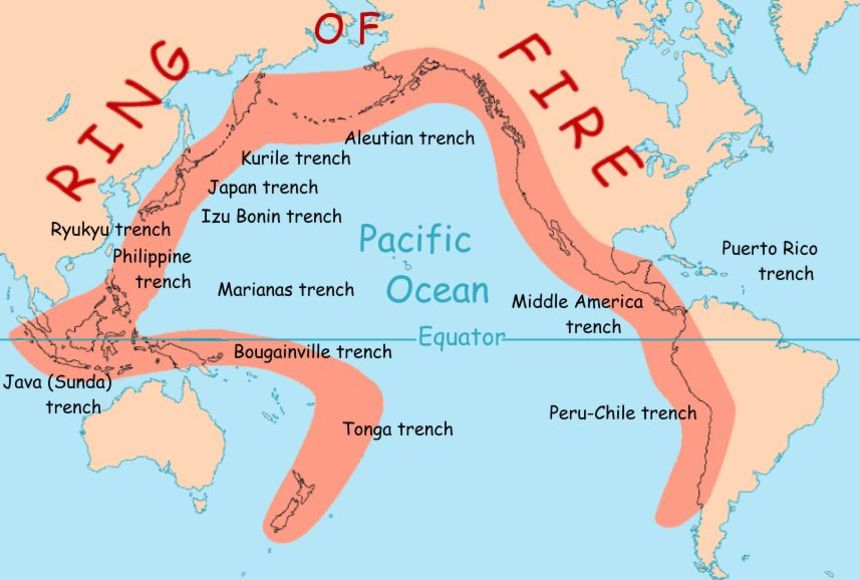
It’s the earth’s bad temper writ large, a simmering, shuddering belt of geological indigestion where continents grind their teeth and occasionally spit fire.
What if, not one but several volcanoes let rip their collective bad moods at roughly the same time?
As of 1 April 2025, several volcanoes around the world are exhibiting mentionable activity and still venting their anger:
Reykjanes Peninsula, Iceland: erupted 7 times since 10 November 2024
Kīlauea, Hawaii, USA erupted on 23 December 2024
Poás Volcano, Costa Rica: erupted early 2025
Mount Spurr, Alaska, USA: erupted on 26 March 2025
Kanlaon Volcano, Philippines: erupted on 1 April 2025
Taal Volcano, Philippines: erupted on 1 April 2025
Global Activity: As of 21 February 2025, 45 volcanoes worldwide are in a state of continuous eruption. It’s important to note that “continuous” eruptions may involve intermittent activity rather than persistent daily events.
Impact on crops
The world’s crops are in a spot of bother, which is to say they are failing with the tragic inevitability of a souffle in an earthquake. Across the globe, harvests are shrivelling, wilting, and otherwise giving up the ghost, thanks to a heady cocktail of heat, drought, floods, and, in a particularly modern twist, microplastics – because why stop at ruining the oceans when you can sabotage your sandwiches too?
India’s wheat fields, usually a vision of golden abundance, are now more like an ashen mirage—scorched by a merciless sun that’s pushing temperatures past 40 degrees Celsius. The result? A fourth straight year of dwindling yields, which means the country might have to swallow its pride and start importing what it once had in spades.
Brazil’s coffee crop has been having a torrid time, oscillating between drought and drowning. The rains, ever the capricious divas, arrived late to the party, and now the trees are sulking. The effect on coffee prices? Let’s just say your morning caffeine habit is about to feel like a high-stakes investment.
Meanwhile, soybeans – so beloved of vegans and livestock alike – are looking distinctly nervous. Climate change is creeping up on them like a slow-moving but utterly inevitable disaster movie. Scientists are wringing their hands and issuing dire warnings, but the soybeans, rather unhelpfully, remain silent.
And then there’s those cursed microplastics. Once content with choking turtles and cluttering up the food chain, these tiny particles have now decided to sabotage plants’ ability to photosynthesise. The upshot? Global food yields could take a 14% nosedive, leaving an extra 400 million people wondering where their next meal is coming from. Progress, ladies and gentlemen.
All in all, the world’s farms are having the kind of year that makes me consider taking up foraging.
Finally a mention of the 7.7 earthquake in Myanmar. Earthquake not volcano. The country is not in the Ring of Fire but is still prone to earthquakes that mess with a country’s long-suffering population and food output.
It’s not time to pull up the drawbridge and prepare for a siege, but it is time to become cautious and more aware of escalating food prices.
Graeme Dinnen
ResourcesForLife.net
Leave a Reply