You’re aware, at least in a half-hearted, vaguely guilty sort of way, of the creeping horrors wrought by sitting too much.
But let’s be honest, you’ve probably done next to nothing about it, and right now, here you are, sinking into your chair as you read this.
If that stung even a little, well… excellent. That prick of discomfort might just be the only thing capable of dragging you out of your sedentary stupor. Consider it your only hope.
What changed my perception was a conversation that took place many years ago…..
I remember the way he looked at me, not stern, not smug, just faintly sorrowful, as though I’d confessed to microwaving a soufflé.
“You Europeans age because you sit,” he said. “We removed this habit two millennia ago.”
It was delivered without malice. A diagnosis, not an insult. The tone a consultant might use while pointing at a shadow on your X-ray and murmuring, Yes, that’s the trouble. You’ve been marinating in your own convenience.
In the West, we have engineered life into right angles and upholstery. We sit to work, sit to eat, sit to travel, sit to recover from the exhaustion of all that sitting. We have turned the chair into a throne and then chained ourselves to it.
Meanwhile, he explained, in China movement was never exiled to Lycra or New Year’s resolutions. It was folded quietly into the day, as ordinary as tea.
“Man wasn’t made to collapse into chairs,” he said. “Stillness is not a habitat.”
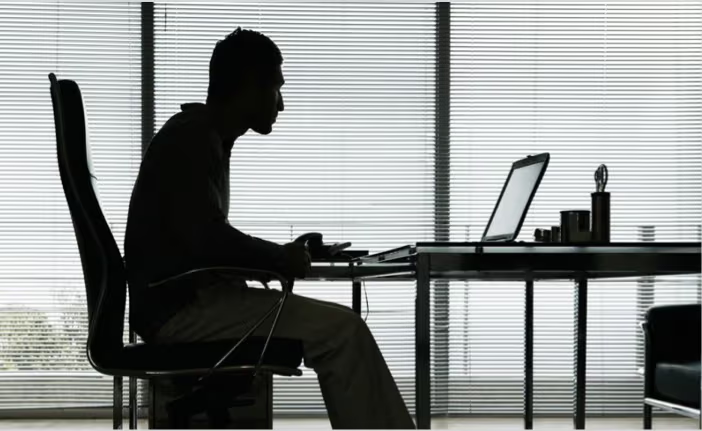
And when you think about it, he’s right. Watch a child: they squat like philosophers in a marketplace, spring up, fold down again, spin, stretch, wander. Then watch an adult in London: vertebrae fused to an office chair, glowing blue in the light of a spreadsheet, ossifying gently before lunch.
People in the Western world spend small fortunes to delay their ageing process.
He told me that eight to ten hours of sitting doesn’t merely make you tired, it accelerates decay.
“Eight extra years,” he said. “Not from time. From stagnation.”
Not dramatic years. Not cinematic decline. Just the slow betrayal of joints, the sulk of circulation, the body muttering, Is this it? Is this all we’re doing now?
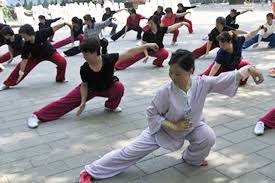
While we outsource vitality to the gym – a sort of penitential hour of sweating between cappuccinos – Chinese children grow up with Tai Chi and Qigong: slow, deliberate movements that look like choreography for invisible birds.
Grandparents in parks move at dawn with a serenity that makes our treadmill sprints seem hysterical.
Then he said something that landed rather harder.
“Western medicine treats symptoms. We prevent them.”
We swallow tablets for twinging backs, sore shoulders and necks ruined by chairs we refuse to abandon. We ice knees that haven’t bent properly since university. We medicalise what is, at heart, architectural folly.
They, he said, simply designed life differently. Study while standing. Walk to talk. Build spaces that encourage drifting, not docking. In old temples and schools, stillness was transitional, not permanent, a pause, not a postcode.
I asked him what we were supposed to do, given that our civilisation is upholstered. Our offices swivel. Our cars recline. Even our leisure requires lumbar support.
He laughed – not unkindly.
“Stand up. Every hour.”
That was it. No incense. No Himalayan pilgrimage. Just a minute. Sixty seconds of squats, or a lap around the room, or even standing tall enough to remind your spine it has ambitions.
“Sixty seconds,” he said, “and you erase most of that hour.”
No marathons. No heroic reinventions. Just a refusal to surrender entirely to gravity and furniture.
But the sharpest cut came at the end.
“Aging doesn’t begin with wrinkles,” he said. “It begins the day you stop moving.”
We imagine old age as a number – fifty, sixty, eighty. He suggested it is a posture. A decision repeated daily. The quiet choice to remain seated when you could rise.
And suddenly our culture….efficient, productive, upholstered….seemed less advanced and more embalmed. Rows of us, gently stiffening in ergonomic coffins, proud of how comfortable we’ve become.
I stood up while he was still speaking.
Not dramatically. Just enough to feel the blood remember its route.
Graeme Dinnen
ResourcesForLife.net
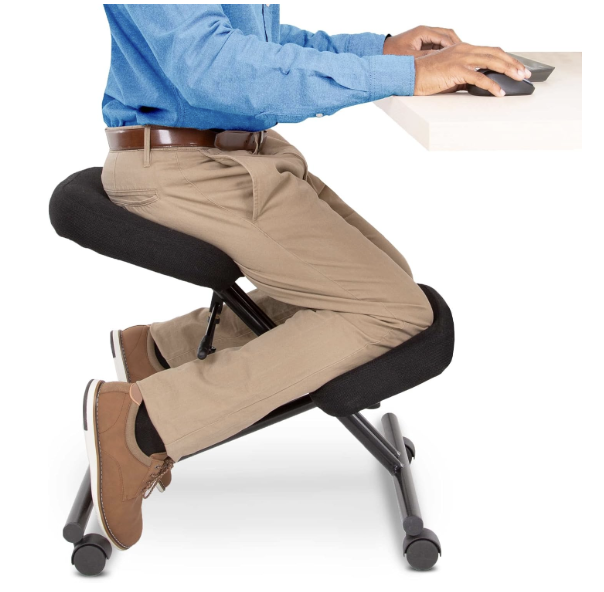
PS. The notion of perching on your shins like a penitent monk is hardly a novelty cooked up by some ergonomic evangelist. People have been folding themselves into kneeling poses for centuries, from the meditative stillness of Buddhist practice to the disciplined neatness of the Japanese seiza position, all ankles tucked and spine upright as a broom handle.
What is new, or at least new-ish, is the wheeled, foam-padded contraption that crept out of Scandinavia in the 1970s and tried to pass itself off as office furniture. The modern kneeling chair, as we now know it, was born in Norway: a land so sensible about backs and posture that even sitting down comes with moral instruction.
I’ve used one of these since I first came across them in the 1980’s. Sitting this way encourages a straight back!
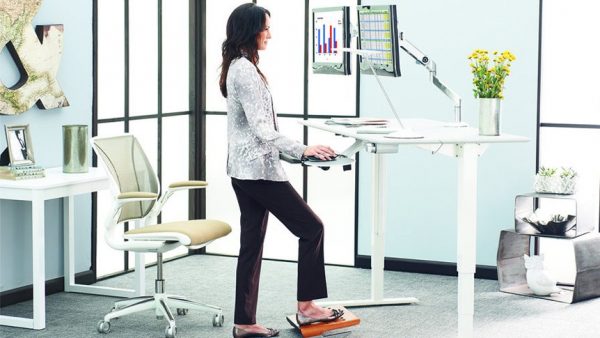
….or get yourself a standing desk. Many schools have adopted this in their classrooms